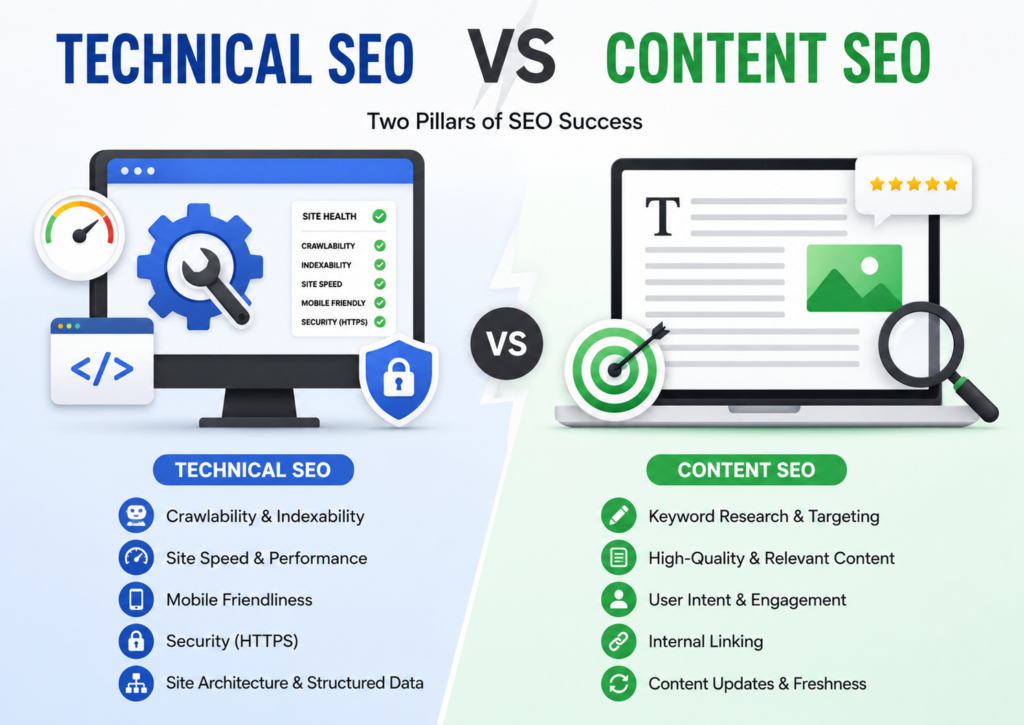
Technical SEO vs Content SEO is one of the most common debates in search engine optimization. Many website owners spend months creating blog posts but ignore technical issues. Others focus heavily on site speed, indexing, and crawlability while neglecting content quality.
The truth is simple. Technical SEO vs Content SEO is not a battle where one side wins. Search engines need both. Technical SEO helps search engines access, crawl, and understand your website. Content SEO helps search engines determine whether your pages deserve visibility for relevant searches.
Think of your website as a car. Technical SEO is the engine, tires, and fuel system. Content SEO is the driver. Without a working engine, the driver cannot move. Without a driver, the car has no direction.
Understanding how these two SEO disciplines work together can help you build sustainable rankings, improve user experience, and increase organic traffic.
What Is Technical SEO?
Technical SEO focuses on optimizing the technical foundation of a website so search engines can crawl, index, and understand pages efficiently.
It deals with elements that users may never notice directly, but search engines rely on heavily.
Some of the most important technical SEO factors include:
- Website speed
- Mobile friendliness
- XML sitemaps
- Robots.txt configuration
- HTTPS security
- Structured data
- Internal linking architecture
- Crawlability
- Indexability
- Core Web Vitals
A technically optimized website makes it easier for search engines to discover and process content.
Why Technical SEO Matters
Search engines allocate limited crawl resources to every website. When technical issues block crawlers, valuable pages may never appear in search results.
For example:
- Broken internal links waste crawl budget.
- Slow pages create poor user experiences.
- Duplicate content confuses search engines.
- Indexing issues prevent rankings altogether.
Even exceptional content struggles to rank if search engines cannot access it properly.
What Is Content SEO?
Content SEO focuses on creating, organizing, and optimizing content that satisfies user intent.
The goal is not simply to add keywords. Modern SEO content must answer questions, solve problems, and provide useful information.
Content SEO includes:
- Keyword research
- Search intent optimization
- Content structure
- Topic coverage
- Internal linking
- Content freshness
- Semantic SEO
- On page optimization
- User engagement signals
Content helps search engines understand what a page is about and whether it deserves visibility.
Why Content SEO Matters
Google’s ranking systems prioritize content that demonstrates experience, expertise, authority, and trust.
A technically perfect website with weak content rarely performs well because users have no reason to engage with it.
Strong content can:
- Attract backlinks naturally
- Increase organic traffic
- Improve engagement metrics
- Build topical authority
- Strengthen brand trust
Content remains the primary reason users visit a website.


Technical SEO vs Content SEO: What Is the Difference?
The biggest difference lies in their purpose.
| Technical SEO | Content SEO |
|---|---|
| Improves crawlability | Improves relevance |
| Supports indexing | Targets user intent |
| Enhances website performance | Enhances content quality |
| Helps search engines access pages | Helps search engines understand value |
| Focuses on infrastructure | Focuses on information |
Technical SEO creates accessibility.
Content SEO creates value.
You need both to compete effectively in modern search results.
Which Comes First: Technical SEO or Content SEO?
Many beginners ask whether they should prioritize technical optimization or content creation.
The answer depends on the condition of the website.
If your website suffers from major technical issues, fix them first.
Examples include:
- Pages blocked from indexing
- Broken navigation
- Slow loading speeds
- Mobile usability problems
- HTTPS errors
Publishing content on a technically broken website creates unnecessary limitations.
However, once the technical foundation is stable, content should become an ongoing priority.
The ideal approach combines both strategies from the beginning.
Why Can Great Content Fail Without Technical SEO?
Many website owners create outstanding articles that never rank.
The reason often has nothing to do with content quality.
Several technical issues can limit visibility:
Poor Crawlability
Search engines must discover pages before ranking them.
Weak internal linking structures can leave valuable content isolated.
Slow Website Speed
Users expect fast-loading websites.
When pages load slowly, visitors leave quickly, increasing bounce rates and reducing engagement.
Mobile Experience Problems
Most searches now happen on mobile devices.
Poor mobile usability affects user satisfaction and search visibility.
Indexing Errors
If pages remain excluded from search indexes, rankings become impossible regardless of content quality.
This is why every Technical SEO checklist should include regular indexing and crawlability reviews.



Why Can Perfect Technical SEO Fail Without Content SEO?
Technical optimization alone cannot answer search queries.
Imagine searching for “best running shoes for beginners” and finding a page with excellent page speed but only 100 words of generic content.
Users would leave immediately.
Search engines evaluate usefulness.
Without valuable content:
- Rankings remain limited.
- Engagement stays low.
- Backlinks become difficult to earn.
- Authority growth slows down.
Technical SEO creates opportunities.
Content SEO converts those opportunities into rankings.
How Does Technical SEO Support Content Performance?
Technical optimization directly impacts content visibility.
Better Indexation
Search engines discover content faster when websites have clean architecture and optimized sitemaps.
Improved User Experience
Fast pages encourage users to stay longer and consume more content.
Enhanced Internal Linking
Strong technical architecture distributes authority across important pages.
Rich Results Opportunities
Structured data can help content appear with enhanced search features.
Technical SEO optimization tips often focus on improving these areas because they amplify content performance.
What Are the Most Important Technical SEO Best Practices?
Every website should follow several core technical principles.
Optimize Core Web Vitals
Focus on:
- Loading speed
- Visual stability
- Responsiveness
Faster websites generally create better user experiences.
Use HTTPS
Security has become a standard expectation for users and search engines.
Create XML Sitemaps
Sitemaps help search engines discover important pages efficiently.
Fix Crawl Errors
Regularly monitor crawl reports and resolve issues quickly.
Improve Internal Linking
Strong internal linking helps distribute authority and improve page discovery.
Ensure Mobile Friendliness
Responsive design is essential for modern SEO success.
These technical SEO best practices create a solid foundation for growth.

What Are the Most Important Content SEO Best Practices?
Content optimization requires more than keyword placement.
Understand Search Intent
Every search query has a purpose.
Content should match what users expect to find.
Cover Topics Thoroughly
Comprehensive content often performs better than shallow content.
Use Clear Headings
Logical structure improves readability and helps search engines understand content.
Include Semantic Keywords
Related terms help strengthen topical relevance.
Update Existing Content
Fresh content can maintain relevance and improve rankings over time.
Following these content SEO best practices improves both user experience and search performance.
Technical SEO vs On Page SEO: Are They the Same?
Many people confuse Technical SEO vs on page SEO.
They overlap, but they are different.
Technical SEO focuses on infrastructure.
On page SEO focuses on page level optimization.
Examples of on page SEO include:
- Title tags
- Meta descriptions
- Heading structure
- Keyword placement
- Content formatting
Technical SEO focuses on:
- Site speed
- Crawlability
- Indexation
- Structured data
- Security
Both contribute to overall SEO performance.
What Should a Technical SEO Audit Guide Include?
A comprehensive technical audit should review:
Crawlability: Check whether search engines can access pages properly.
Indexation: Verify that important pages appear in search indexes.
Site Speed: Identify performance bottlenecks.
Internal Links: Look for orphan pages and broken links.
Mobile Usability: Evaluate the mobile experience carefully.
Structured Data: Ensure schema markup is implemented correctly.
Security: Confirm HTTPS implementation across the entire site.
A detailed Technical SEO audit guide helps uncover hidden issues before they affect rankings.
What Should a Content SEO Audit Checklist Include?
Content audits reveal opportunities for improvement.
Review:
- Content quality
- Search intent alignment
- Keyword targeting
- Internal linking
- Outdated information
- Thin content
- Duplicate content
- Engagement metrics
A Content SEO audit checklist helps maintain content quality across large websites.
Technical SEO Tools Comparison: Which Tools Are Useful?
Several tools assist with technical analysis.
Popular options include:
- Google Search Console
- Google PageSpeed Insights
- Screaming Frog
- Sitebulb
- Ahrefs
- Semrush
Each tool offers unique strengths.
Google Search Console remains essential because it provides direct insights into indexing, crawling, and search performance.
A proper Technical SEO tools comparison should focus on website size, budget, and specific auditing needs.
How Can Beginners Balance Technical SEO and Content SEO?
Technical SEO for beginners often feels overwhelming.
The good news is that you do not need advanced expertise immediately.
Start with:
- Mobile friendly design
- Fast hosting
- HTTPS security
- XML sitemap setup
- Clear website structure
Then focus on content.
Create useful articles that answer real questions from your audience.
This balanced approach delivers better long term results than focusing on only one area.
Why Is Technical and Content SEO Integration Essential?
The highest performing websites rarely treat SEO as separate departments.
They combine technical excellence with valuable content.
Technical and Content SEO integration creates:
- Better user experiences
- Stronger rankings
- Faster indexing
- Higher engagement
- Improved authority
When technical teams and content teams work together, websites become easier to discover, understand, and trust.
Frequently Asked Questions
Which is more important: Technical SEO or Content SEO?
Both are important. Technical SEO helps search engines access and understand your website, while Content SEO helps search engines determine whether your content deserves to rank. Strong rankings usually require both.
Can Content SEO work without Technical SEO?
Content SEO can generate some visibility without perfect technical optimization, but major technical issues can prevent search engines from crawling, indexing, or ranking content effectively.
Can Technical SEO improve rankings without new content?
Technical improvements can increase visibility by fixing crawl issues, improving page speed, and enhancing user experience. However, long term growth typically requires high quality content as well.
What are the most important Technical SEO factors?
Key Technical SEO factors include website speed, mobile friendliness, HTTPS security, XML sitemaps, structured data, internal linking, crawlability, indexability, and Core Web Vitals.
What are the most important Content SEO factors?
Important Content SEO factors include keyword research, search intent optimization, content quality, topical authority, semantic keywords, internal linking, and content freshness.
How often should I perform a Technical SEO audit?
Most websites should conduct a Technical SEO audit every three to six months. Large websites, ecommerce stores, and frequently updated sites may require more frequent audits.
What is a Technical SEO checklist?
A Technical SEO checklist is a list of tasks used to evaluate crawlability, indexability, site speed, mobile usability, HTTPS security, structured data, XML sitemaps, and internal linking.
Is Technical SEO part of On Page SEO?
No. Technical SEO and On Page SEO are different. Technical SEO focuses on website infrastructure, while On Page SEO focuses on elements such as title tags, headings, meta descriptions, and content optimization.
How does Technical SEO affect Content SEO?
Technical SEO helps search engines discover, crawl, and index content efficiently. Better technical performance can increase the visibility and effectiveness of content SEO efforts.
What tools are best for Technical SEO?
Popular Technical SEO tools include Google Search Console, Google PageSpeed Insights, Screaming Frog, Ahrefs, Semrush, and Sitebulb.
Should beginners focus on Technical SEO or Content SEO first?
Beginners should establish a solid technical foundation by ensuring their website is crawlable, secure, and mobile friendly. After that, they should focus heavily on creating high quality content that satisfies user intent.
Why do some websites rank with weak content but strong Technical SEO?
Strong technical optimization can help websites maximize existing content performance. However, sustained rankings usually require useful, relevant, and authoritative content.
How do Technical SEO and Content SEO work together?
Technical SEO creates a foundation that helps search engines access and understand pages, while Content SEO provides the information and relevance needed to satisfy user queries. Together, they improve rankings, traffic, and user experience.
Conclusion
The debate around Technical SEO vs Content SEO often misses the bigger picture.
Neither strategy wins on its own.
Technical SEO ensures search engines can crawl, index, and understand your website. Content SEO gives users the information they need and provides search engines with signals of relevance and quality.
If technical SEO builds the foundation, content SEO builds the house.
Websites that invest in both areas consistently outperform competitors who focus on only one side of the equation. Instead of choosing between Technical SEO and Content SEO, build a strategy where each strengthens the other. That combination creates the strongest path toward sustainable organic growth.