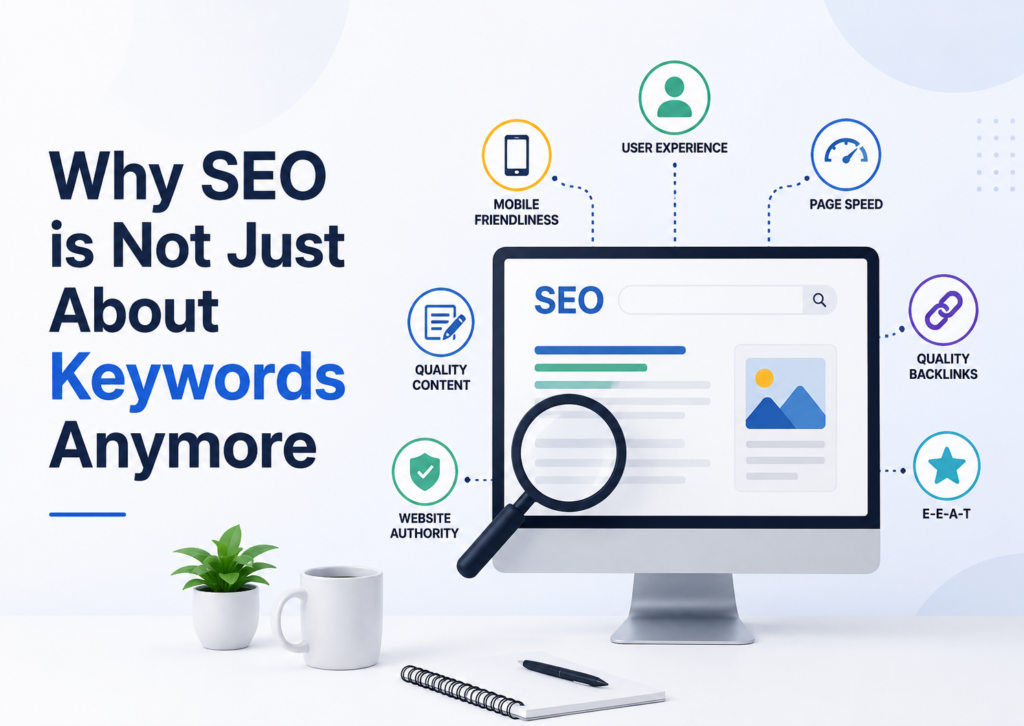
For years, marketers treated SEO as a keyword game. Find the right phrase, place it throughout a page, build a few links, and wait for rankings to rise. Today, that approach no longer works. Modern SEO requires a broader strategy focused on users, content quality, expertise, and search intent. Modern SEO is no longer just about keywords. Modern SEO is about understanding people and helping them find exactly what they need.
Search engines have evolved dramatically. Google’s algorithms now evaluate content through hundreds of signals that extend far beyond keyword placement. User behavior, page experience, topical authority, and trustworthiness all influence visibility. As artificial intelligence reshapes search, businesses that rely solely on keyword optimization risk falling behind.
The new SEO rules reward websites that provide meaningful value. Success comes from creating content that answers questions, solves problems, and builds credibility within a topic area. Understanding these changes can help businesses attract sustainable organic traffic and stay competitive in a constantly evolving search landscape.
Why Has SEO Changed So Much?
Search engines have one primary goal: deliver the most helpful result for every query.
In the early days of search, algorithms relied heavily on keywords because they had limited ways to understand content. Website owners quickly discovered that repeating keywords could improve rankings. As a result, search results often became cluttered with low-quality pages designed for algorithms rather than people.
Google spent years improving its ability to understand language, context, and user satisfaction. Major algorithm updates focused on rewarding quality while reducing the visibility of manipulative tactics.
Today, search engines can interpret relationships between concepts, identify expertise, measure engagement signals, and understand user intent with remarkable accuracy. The result is a search ecosystem where value matters more than keyword repetition.
What Does Modern SEO Really Mean?
Modern SEO focuses on creating the best possible experience for users while helping search engines understand content clearly.
Keywords still matter. They help search engines identify topics and relevance. However, keywords now serve as starting points rather than the entire strategy.
Modern SEO combines several elements:
- Search intent optimization
- User experience SEO
- Content quality signals
- E-E-A-T principles
- Semantic SEO
- Topical authority development
- Technical performance
- AI-driven search visibility
These components work together to improve rankings and drive long-term organic traffic growth.
A website that excels in all these areas often outperforms competitors even when they target identical keywords.



What Is Search Intent Optimization and Why Does It Matter?
Search intent optimization has become one of the most important ranking factors in modern SEO.
Every search query reflects a specific goal. Users may want information, products, services, comparisons, or solutions. Search engines aim to match content with that goal.
Consider someone searching for “best running shoes.” They likely want recommendations and comparisons. Someone searching for “buy running shoes online” has a transactional intent and expects product pages or stores.
Creating content that aligns with intent increases relevance and user satisfaction.
The Four Main Types of Search Intent
Informational Intent
Users seek knowledge or answers.
Examples include:
- What is semantic SEO?
- How does Google rank websites?
- Why is organic traffic important?
Navigational Intent
Users want a specific website or brand.
Examples include:
- Google Search Console
- YouTube Studio
- LinkedIn login
Commercial Investigation
Users compare options before making decisions.
Examples include:
- Best SEO tools
- Top content marketing platforms
- Ahrefs vs Semrush
Transactional Intent
Users are ready to take action.
Examples include:
- Buy SEO software
- Hire SEO consultant
- Order website audit
Understanding intent helps content creators match user expectations and improve rankings naturally.
How Does User Experience SEO Influence Rankings?
Imagine entering a store where products are scattered everywhere, lights flicker constantly, and checkout takes ten minutes.
You probably would not stay long.
Websites work the same way.
User experience SEO focuses on how visitors interact with a website. Search engines increasingly prioritize sites that provide fast, accessible, and enjoyable experiences.
Google’s focus on user experience became more visible through Core Web Vitals, which measure important performance indicators.
Key User Experience Signals
Page Speed
Users expect pages to load quickly.
Slow websites increase bounce rates and reduce engagement. Faster pages create better experiences and support stronger rankings.
Mobile Friendliness
Most searches now occur on mobile devices.
Responsive design ensures content remains easy to read and navigate across screen sizes.
Clear Navigation
Users should find information without confusion.
Simple menus, logical structure, and intuitive design improve usability and encourage deeper engagement.
Readability
Large walls of text discourage readers.
Short paragraphs, descriptive headings, and conversational language make content easier to consume.
When visitors enjoy their experience, they stay longer, explore additional pages, and interact more frequently. These behaviors send positive signals to search engines.
What Are Content Quality Signals?
Content quality signals help search engines determine whether information deserves visibility.
High-quality content does more than contain relevant keywords. It demonstrates usefulness, depth, accuracy, and originality.
Google repeatedly emphasizes creating helpful content for people rather than algorithms.
Characteristics of High-Quality Content
Comprehensive Coverage
Strong content answers primary questions while addressing related concerns.
For example, an article about semantic SEO should also discuss search intent, entity relationships, content relevance, and topical authority.
Accuracy
Reliable information builds trust.
Factually correct content performs better because users and search engines value credibility.
Original Insights
Unique perspectives differentiate content from competitors.
Readers appreciate fresh ideas instead of recycled information.
Clarity
Complex topics should remain understandable.
Clear explanations improve engagement and retention.
Content quality has become a major competitive advantage in crowded industries.



What Is E-E-A-T and Why Is It Important?
E-E-A-T stands for Experience, Expertise, Authority, and Trust.
Google uses these concepts to evaluate content quality and credibility.
Although E-E-A-T itself is not a direct ranking factor, it influences many signals that affect rankings.
Experience
Experience refers to firsthand knowledge.
Content created by individuals who have actually used a product, solved a problem, or worked within an industry often provides more value than generic summaries.
Readers can recognize authentic experience quickly.
Expertise
Expertise demonstrates deep understanding.
Writers should possess sufficient knowledge to explain topics accurately and confidently.
Industry professionals often produce stronger content because they understand real-world challenges and solutions.
Authority
Authority develops over time.
Websites earn authority through consistent publishing, quality backlinks, mentions, citations, and recognition from reputable sources.
Authority tells search engines that a website deserves attention.
Trust
Trust forms the foundation of E-E-A-T.
Secure websites, transparent policies, accurate information, and clear author credentials help establish trustworthiness.
Without trust, expertise and authority lose much of their impact.
How Does Topical Authority Improve SEO Performance?
Topical authority has become one of the strongest indicators of relevance.
Instead of publishing isolated articles on random subjects, successful websites build comprehensive coverage around specific themes.
Search engines recognize patterns.
A website with dozens of interconnected articles about SEO signals deeper expertise than a site with only one SEO article among unrelated topics.
Building Topical Authority
Start with a core topic.
Then create supporting content covering related subtopics.
For SEO, that might include:
- Search intent
- Keyword research
- Technical SEO
- Link building
- Content marketing
- User experience
- Local SEO
- Semantic SEO
Internal linking strengthens these relationships and helps search engines understand topic depth.
Over time, topical authority increases credibility and ranking potential across an entire subject area.
What Is Semantic SEO?
Semantic SEO focuses on meaning rather than exact keyword matching.
Modern search engines understand relationships between words, concepts, and entities.
For example, an article about digital marketing may naturally mention content marketing, social media, SEO, PPC advertising, analytics, and customer acquisition.
These related concepts help search engines understand context.
Why Semantic SEO Matters
Users phrase questions differently.
One person may search for “improve website rankings.”
Another may search for “increase organic visibility.”
Both searches often share similar intent.
Semantic SEO helps content rank for broader sets of related queries without excessive keyword repetition.
How to Apply Semantic SEO
Use natural language.
Cover related concepts.
Answer follow-up questions.
Include context that demonstrates topic depth.
Think about subjects instead of individual keywords.
This approach aligns with how modern search engines interpret information.



How Have Google Ranking Factors Evolved?
Google ranking factors continue to evolve as technology advances.
While exact algorithms remain confidential, several themes consistently appear across updates.
Relevance
Content must match user intent.
Relevance remains a foundational ranking factor.
Quality
Comprehensive, accurate content tends to outperform thin pages.
Authority
Backlinks still matter because they signal credibility.
Quality matters more than quantity.
User Experience
Fast, secure, mobile-friendly websites perform better.
Engagement
Search engines monitor signals that indicate satisfaction.
Content that keeps users engaged often gains stronger visibility.
Freshness
Some topics require updated information.
Regular content maintenance helps preserve relevance.
The common theme remains clear: help users effectively and rankings often follow.
What Is Zero-Click Search and How Should Marketers Respond?
Zero-click search occurs when users receive answers directly on search results pages.
Featured snippets, knowledge panels, AI summaries, local packs, and instant answers often satisfy searches without requiring a website visit.
This trend has transformed SEO strategy.
At first glance, zero-click search may seem like bad news.
However, visibility still creates value.
Appearing in featured positions increases brand awareness, authority, and trust.
Strategies for Zero-Click Search
Provide concise answers near the beginning of content.
Use clear heading structures.
Answer common questions directly.
Include supporting detail after providing initial responses.
Optimize for featured snippets and AI-generated summaries.
The goal shifts from simply earning clicks to becoming a trusted information source.
How Is Artificial Intelligence Changing SEO?
Artificial intelligence has become one of the biggest forces shaping search.
Search engines use AI to understand language, intent, context, and content quality more effectively than ever before.
AI-powered search experiences continue to evolve.
Users increasingly receive synthesized answers generated from multiple sources.
Opportunities Created by AI
AI rewards content that demonstrates expertise and originality.
Generic content faces growing challenges because AI systems can summarize basic information instantly.
Websites must provide insights that machines cannot easily replicate.
Real experience, unique analysis, expert opinions, and practical examples become more valuable.
AI and Content Creation
AI tools can improve productivity.
They help generate outlines, organize ideas, and identify opportunities.
However, human oversight remains essential.
The strongest content combines AI efficiency with human expertise.
Search engines prioritize value, not the method used to create content.
How Can Businesses Achieve Sustainable Organic Traffic Growth?
Organic traffic growth requires consistency rather than shortcuts.
Businesses often chase quick wins and temporary ranking boosts.
Sustainable growth comes from building assets that continue delivering value over time.
Focus on User Needs
Understand audience challenges.
Create content that solves real problems.
Useful content attracts visitors naturally.
Build Content Clusters
Develop interconnected resources around core topics.
This strategy strengthens topical authority and improves visibility.
Improve User Experience
Fast websites encourage engagement.
Better experiences increase conversions and retention.
Earn Trust
Publish accurate information.
Show expertise.
Maintain transparency.
Trust supports long-term SEO success.
Organic growth often accelerates once these elements work together.
What Does an Effective Content Strategy Look Like Today?
An effective content strategy starts with audience understanding.
Before creating content, identify user goals, challenges, and search behavior.
Keyword research remains important, but strategy should extend beyond search volume metrics.
Create Content Around Topics
Focus on complete subject coverage.
Build resources that answer multiple related questions.
This approach supports semantic SEO and topical authority.
Prioritize Quality Over Quantity
Ten exceptional articles often outperform one hundred mediocre ones.
Quality creates stronger engagement and more opportunities for backlinks.
Update Existing Content
Content maintenance remains essential.
Refreshing outdated information preserves relevance and improves performance.
Measure Performance
Track organic traffic, engagement, rankings, and conversions.
Use insights to refine future content decisions.
The best content strategies evolve continuously based on audience needs and search trends.
The Future of SEO Belongs to Helpful Brands
The era of keyword stuffing and simplistic optimization has ended.
Keywords still matter, but they represent only one piece of a much larger puzzle. Modern SEO combines search intent optimization, user experience SEO, content quality signals, E-E-A-T principles, topical authority, semantic SEO, and emerging AI-driven practices.
Search engines continue moving closer to human understanding. They evaluate context, credibility, usefulness, and satisfaction rather than counting keyword occurrences. Businesses that embrace this shift gain a significant advantage.
The future belongs to brands that educate, assist, and build trust. They create content that genuinely helps people accomplish goals. They understand user intent, provide exceptional experiences, and demonstrate real expertise.
SEO is no longer about convincing search engines that content deserves rankings. It is about proving to users that content deserves attention.
When you focus on helping people first, search visibility becomes a natural outcome. That principle remains the most important SEO rule of all.