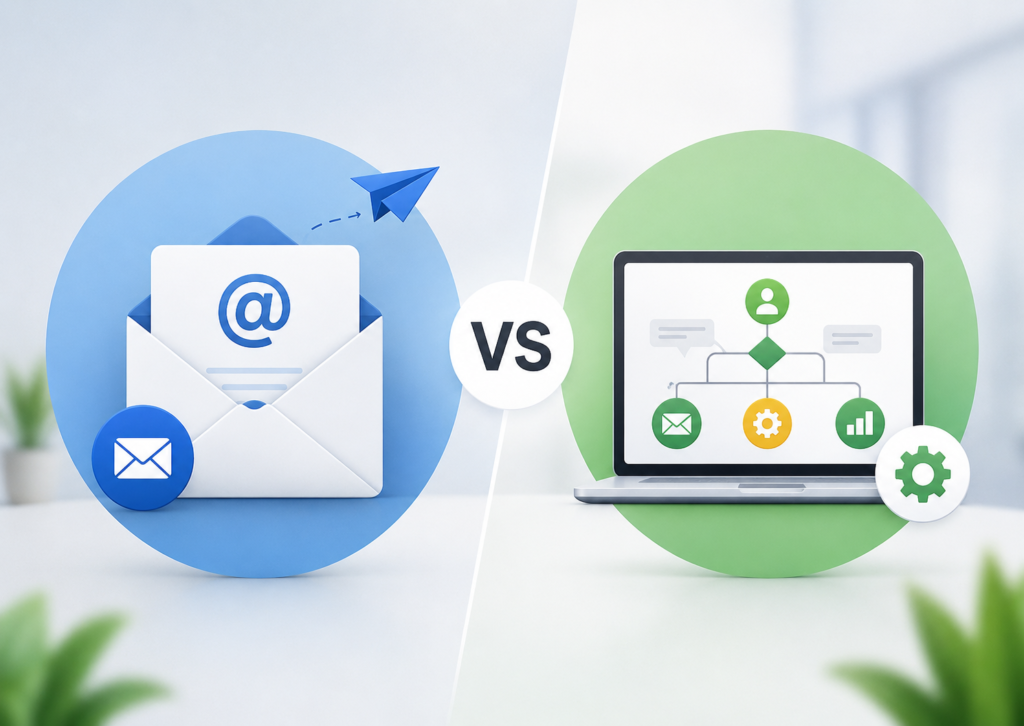
If you are comparing email marketing vs marketing automation, you are probably trying to answer a simple question: Which one should my business use?
The answer depends on what you want to achieve.
Email marketing helps businesses communicate with an audience through email campaigns, newsletters, promotional emails, and other targeted messages. Marketing automation goes further. It can coordinate automated customer journeys based on a person’s actions, characteristics, or position in the customer lifecycle.
That means the difference between email marketing and marketing automation is not simply “manual emails versus automatic emails.” Modern email marketing platforms can automate many tasks, while marketing automation platforms can manage activities that extend beyond email.
Think of email marketing as one important tool in your marketing toolbox. Marketing automation is closer to the toolbox itself.
So, when comparing marketing automation vs email marketing, the real question is not which one is universally better. It is which approach fits your audience, sales funnel, team, and business goals.
What Is Email Marketing?
Email marketing is the practice of communicating with people through email. Businesses use it to build relationships, share information, promote products or services, and encourage customers to take action.
Common examples include:
- Newsletters
- Promotional emails
- Product announcements
- Welcome emails
- Event invitations
- Educational content
- Customer updates
- Automated email campaigns
An email marketing platform typically helps businesses create email campaigns, manage subscribers, segment audiences, personalize content, and measure results.
For example, an online store might send a newsletter to customers every Friday. The business could also segment subscribers based on previous purchases and send different promotional emails to different groups.
That is email marketing in action.
Modern email marketing tools can also offer automation features. You might create a welcome email sequence that sends one message immediately after someone subscribes and another a few days later.
This is often called automated email marketing or email marketing automation.
However, the core focus remains email communication.
What Is Marketing Automation?
Marketing automation uses software to automate marketing processes and customer interactions based on predefined rules, triggers, and workflows.
Instead of simply sending an email to a list, a marketing automation platform can help businesses manage a broader customer journey.
Depending on the platform, this may include:
- Email automation
- Customer segmentation
- Lead scoring
- Lead nurturing
- Behavioral targeting
- CRM integration
- Workflow automation
- Conversion tracking
- Engagement tracking
- Marketing analytics
- Multi-channel marketing
For example, imagine someone downloads a guide from your website.
A marketing automation workflow could identify that action, add the person to an appropriate audience, send a relevant email, update their profile in a connected CRM, assign a lead score, and notify a sales team when the person reaches a certain level of engagement.
The exact capabilities vary by software, so businesses should always check the features offered by a specific platform.
The important point is that marketing automation focuses on managing customer interactions and marketing workflows across a broader process.

Email Marketing vs Marketing Automation: The Main Difference
The simplest way to understand the difference between email marketing and marketing automation is to look at their scope.
Email marketing primarily focuses on communication through email.
Marketing automation focuses on automating marketing processes and customer journeys, often using email as one part of the system.
| Area | Email Marketing | Marketing Automation |
|---|---|---|
| Primary focus | Email communication | Marketing process automation |
| Newsletters | Yes | Often supported |
| Promotional emails | Yes | Yes |
| Email campaigns | Core function | Often included |
| Automated emails | Common | Common |
| Segmentation | Common | Advanced capabilities may be available |
| Email workflows | Yes, depending on platform | Yes |
| Lead nurturing | Possible | Core use case for many platforms |
| Lead scoring | Limited or unavailable on some platforms | Common in advanced platforms |
| CRM integration | Varies | Common in many platforms |
| Multi-channel marketing | Usually limited | Often supported |
| Customer journey automation | Basic to advanced | More comprehensive |
| Analytics | Campaign-focused | Broader marketing and journey reporting |
The table shows why email marketing vs automation can become confusing.
The two categories overlap.
An email platform can automate messages. A marketing automation platform can send emails.
So, email automation vs marketing automation is not always a clean either-or comparison. The key difference lies in the depth and breadth of the automation.
Email Marketing Automation vs Marketing Automation
Let’s make the distinction even clearer.
Email marketing automation generally refers to automated actions that happen within an email marketing process.
For example:
- A visitor subscribes to your newsletter.
- The system sends a welcome email.
- Three days later, it sends an educational email.
- A week later, it sends another relevant message.
This could be an email sequence or drip campaign.
Marketing automation, on the other hand, can connect multiple marketing activities into a larger workflow.
For example:
- A visitor downloads a resource.
- The system records the activity.
- The contact enters a lead nurturing workflow.
- The person receives relevant email content.
- Their engagement affects lead scoring.
- Their information syncs with a CRM.
- A sales team receives a notification when the lead meets specific criteria.
The exact process depends on the platform and integrations.
In other words, email marketing automation vs marketing automation is largely a question of scope.
One focuses on automating email communication. The other can coordinate broader marketing workflows and customer journeys.
Email Campaigns vs Marketing Automation Workflows
Another useful comparison is email campaigns vs marketing automation.
An email campaign usually starts with a specific communication goal.
You might send:
- A seasonal promotion
- A product launch
- A newsletter
- An event invitation
- An educational campaign
You decide who receives the campaign, create the content, schedule it, and then review campaign analytics.
Marketing automation workflows usually work differently.
They respond to customer actions, conditions, or changes in a customer’s lifecycle stage.
For example:
Trigger: Someone fills out a form.
Action: Send a relevant email.
Condition: If the person clicks the email, continue the workflow.
Next action: Send another message or update their contact record.
Sales action: If the lead reaches a defined score, alert the sales team.
This approach can support automated customer journeys instead of relying entirely on one-time campaigns.

Email Marketing Features vs Marketing Automation Features
When comparing email marketing software vs marketing automation software, look beyond the word “automation.”
Different platforms offer different features, and some products sit somewhere between traditional email marketing and full marketing automation.
Common Email Marketing Features
Many email marketing platforms provide features such as:
- Email campaign creation
- Newsletter management
- Email templates
- Subscriber management
- Audience segmentation
- Personalization
- Automated email sequences
- Drip campaigns
- A/B testing
- Campaign analytics
- Engagement tracking
These features can help businesses communicate consistently with subscribers and customers.
Common Marketing Automation Features
Marketing automation platforms may offer a broader set of capabilities, such as:
- Workflow automation
- Lead nurturing
- Lead scoring
- CRM integration
- Behavioral targeting
- Customer journey management
- Lifecycle marketing
- Multi-channel marketing
- Marketing workflow management
- Conversion tracking
- Advanced reporting
Not every platform offers every feature. Some email marketing tools now provide sophisticated automation, while some marketing automation platforms focus heavily on email.
That is why comparing actual features is more useful than comparing product labels.
Email Marketing for Lead Generation vs Marketing Automation for Lead Generation
Both approaches can support lead generation, but they often play different roles.
Email marketing for lead generation can help businesses nurture people who have already opted into communication. Businesses can use useful content, newsletters, educational resources, and relevant offers to keep prospects engaged.
For example, a software company might send educational emails to subscribers who downloaded a guide.
Marketing automation for lead generation can take the process further.
A marketing automation system may connect website forms, customer data, email workflows, lead scoring, and CRM systems. This can help marketing and sales teams understand where a prospect sits in the sales funnel.
For B2B businesses with longer buying cycles, this can be particularly useful.
However, automation does not magically create qualified leads.
You still need a strong offer, useful content, accurate targeting, and a clear customer journey. Software can automate a process. It cannot rescue a bad strategy wearing a fancy dashboard.
Personalization and Segmentation
Both email marketing and marketing automation can use personalization and audience segmentation.
A basic email campaign might segment subscribers based on information such as:
- Location
- Purchase history
- Customer type
- Subscription preferences
More advanced marketing automation may combine these characteristics with behavioral data.
For example, a business could create different workflows based on actions such as visiting a page, downloading a resource, submitting a form, or engaging with previous communications.
This is where email personalization and automation become especially useful.
The goal should not be to personalize everything simply because the software allows it.
The goal is to send a message that makes sense for the person receiving it.
Good personalization feels relevant.
Bad personalization feels like a company knows too much and is trying very hard to prove it.
Email Workflows vs Marketing Automation Workflows
Email marketing workflows typically focus on email-related actions.
A simple workflow might look like this:
New subscriber → Welcome email → Educational email → Product email
Marketing automation workflows can involve more complex logic.
For example:
Form submission → Contact segmentation → Email sequence → Engagement tracking → Lead scoring → CRM update → Sales notification
Again, the exact workflow depends on the capabilities of the platform.
This difference matters when you decide whether you need a dedicated email marketing platform or a broader marketing automation platform.
If your main requirement is sending newsletters, promotions, and automated email sequences, a full marketing automation system may be more than you need.
If your business needs complex lead nurturing automation, CRM integration, and customer journey management, basic email software may not provide enough functionality.
Email Marketing or Marketing Automation: Which Is Better?
So, email marketing or marketing automation which is better?
There is no universal winner.
The better option depends on your business.
Choose Email Marketing If You:
- Primarily communicate through email
- Send newsletters regularly
- Run promotional email campaigns
- Need simple automated email sequences
- Have straightforward audience segmentation needs
- Want an easy-to-manage email marketing platform
- Do not need complex lead scoring or CRM workflows
For many small businesses, creators, ecommerce brands, and organizations with straightforward email needs, email marketing can provide everything they need.
Consider Marketing Automation If You:
- Have a longer sales cycle
- Need advanced lead nurturing
- Manage complex customer journeys
- Want lead scoring
- Need deeper CRM integration
- Use multiple marketing channels
- Need complex marketing workflows
- Want to automate actions based on customer behavior
Marketing automation often makes more sense when your marketing process has enough complexity to justify it.
There is little value in buying a large automation platform if your entire marketing strategy is “send the newsletter on Tuesday.”
Email Marketing vs Marketing Automation Software
The email marketing vs marketing automation software decision should start with your business requirements.
Ask yourself:
What am I trying to automate?
If the answer is mainly email campaigns, newsletters, promotional emails, and simple email sequences, email marketing software may be the better fit.
If the answer includes lead scoring, CRM integration, lead nurturing, behavioral targeting, and multi-step customer journeys, marketing automation software may be more appropriate.
Also consider:
- Number of contacts
- Team size
- Budget
- CRM requirements
- Reporting needs
- Integration requirements
- Sales cycle length
- Number of marketing channels
- Technical complexity
Do not choose software based only on how many features appear on the pricing page.
A platform with 100 features is not automatically better than one with 20. If you only use five features, the extra 95 may simply sit there looking expensive.
Can You Use Email Marketing and Marketing Automation Together?
Yes.
In fact, many businesses use both.
Email remains one of the most common communication channels inside marketing automation workflows.
For example, a business might use an email marketing platform for newsletters and promotional campaigns while using a broader marketing automation system to manage lead nurturing and customer journeys.
In other cases, one platform may handle both functions.
The right setup depends on the business’s size, marketing process, technology stack, and goals.
The important thing is to avoid treating email marketing and marketing automation as competing concepts in every situation.
They can work together.
Email can be the communication channel.
Automation can be the system that decides when, why, and how that communication happens.
Email Automation vs Marketing Automation: A Simple Example
Imagine an online course company.
With basic email automation, a new subscriber might receive:
Day 1: Welcome email
Day 3: Educational email
Day 7: Course promotion
This is a simple automated email sequence.
With broader marketing automation, the workflow might consider additional behavior.
Someone who downloads a course guide could enter a nurturing workflow. If they engage with several emails and visit the pricing page, the system might update their lead score. Depending on the company’s setup, that information could then flow into a CRM or trigger another marketing action.
The first example automates email.
The second example automates a broader marketing process.
That is the practical difference.
The Bottom Line: Email Marketing vs Marketing Automation
The best way to understand email marketing vs marketing automation is to think about scope.
Email marketing focuses primarily on communicating with an audience through email. It is ideal for newsletters, promotional emails, email campaigns, segmentation, and automated email sequences.
Marketing automation takes a broader approach. It can connect email with lead nurturing, customer segmentation, behavioral targeting, CRM integration, lead scoring, and automated customer journeys.
If you have simple email needs, start with email marketing.
If your sales funnel requires complex workflows and coordinated customer journeys, consider marketing automation.
And if your business needs both, you do not have to choose one over the other.
The smartest decision is to choose the technology that matches your actual marketing process, not the one with the longest feature list.
Frequently Asked Questions
Is email automation the same as marketing automation?
No. Email automation is generally a part of marketing automation. Email automation sends messages based on triggers or schedules, while marketing automation can manage broader workflows involving customer behavior, lead nurturing, segmentation, CRM integration, and other marketing activities.
Can email marketing and marketing automation work together?
Yes. Email marketing and marketing automation often work together. Email can serve as a communication channel within automated workflows that respond to customer actions, lifecycle stages, or other predefined conditions.
Do I need marketing automation software to run email campaigns?
No. You can run email campaigns with email marketing software that provides campaign creation, audience management, segmentation, scheduling, and reporting. Marketing automation software becomes more useful when you need complex workflows, lead nurturing, behavioral triggers, or broader customer journey automation.
Which is better: email marketing or marketing automation?
Neither is universally better. Email marketing may be enough for newsletters, promotional campaigns, and simple automated email sequences. Marketing automation is generally more suitable for businesses that need advanced lead nurturing, complex workflows, CRM integration, lead scoring, or automated customer journeys.
Is marketing automation better for lead generation?
Marketing automation can support lead generation by automating lead capture, segmentation, nurturing, and follow-up workflows. However, its value depends on having a well-planned marketing strategy, relevant content, and a clear customer journey.
Can small businesses benefit from marketing automation?
Yes, but small businesses should choose automation based on their actual needs. If a business mainly sends newsletters and promotional emails, an email marketing platform may be sufficient. Marketing automation can become more useful as lead nurturing, customer journeys, CRM integration, and workflow complexity increase.
Sources and Further Reading
For accurate guidance on email marketing practices, privacy, consent, and marketing technology, consult trusted sources such as:
- Google Search Central guidance on creating helpful, reliable, people-first content
- Federal Trade Commission (FTC) guidance on the CAN-SPAM Act
- Information Commissioner’s Office (ICO) guidance on direct marketing and electronic communications
- HubSpot’s educational resources on email marketing and marketing automation
- Salesforce resources covering marketing automation and customer journeys
- Mailchimp’s educational resources on email marketing and automation
Always check the applicable privacy and marketing communication laws in the countries where you operate and where your subscribers live. Requirements can vary by jurisdiction, particularly around consent, unsubscribe mechanisms, and electronic marketing communications.