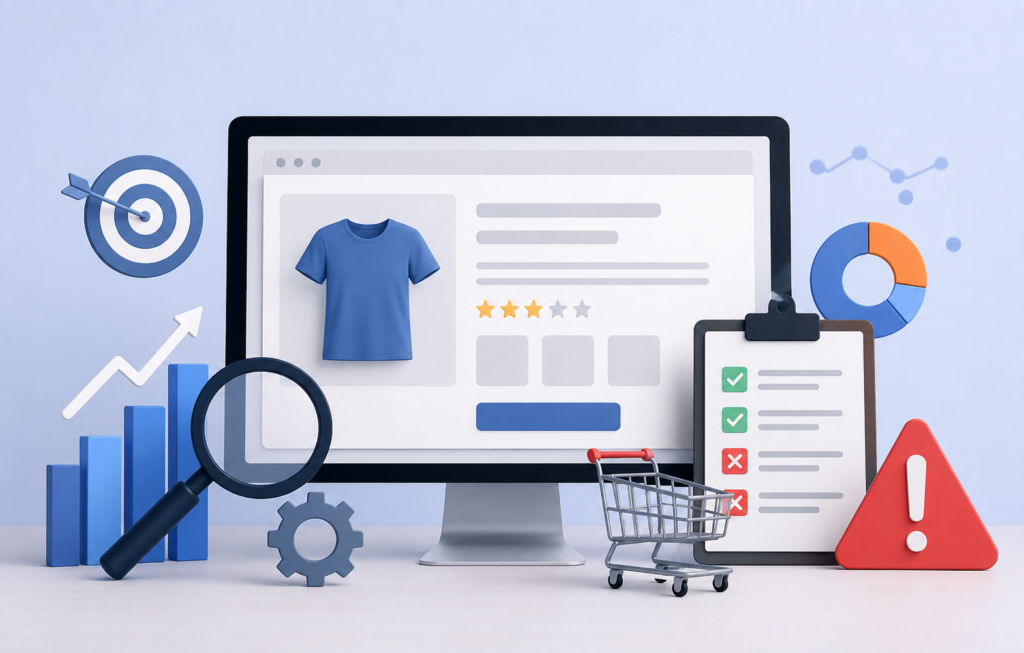
You’ve built your store, added products, and hit publish. Then nothing happens. No traffic, no clicks, no sales. So the question keeps coming back: why are your product pages not ranking?
Most of the time, the answer is not dramatic. It’s not a penalty or some mysterious algorithm curse. It’s usually a mix of small but critical ecommerce SEO issues that quietly hold your pages back.
Search engines want to rank pages that help users. If your product pages fail to explain, guide, or convince, they struggle to earn visibility. This article breaks down the real reasons behind poor rankings and shows you how to fix them using proven product page SEO optimization strategies.
Why Do Product Pages Struggle to Rank in Search Results?
Product pages compete in one of the toughest SEO environments. You’re not just competing with other stores. You’re also competing with marketplaces, blogs, review sites, and even AI-generated summaries.
Search engines evaluate your page based on relevance, usefulness, and trust. If your page misses any of these, it falls behind.
Here are the most common product page ranking factors that impact performance:
- Content quality and depth
- Search intent match
- Page experience and speed
- Internal linking
- Structured data
- Authority and trust signals
Miss a few of these, and your rankings drop. Miss most of them, and your product page becomes invisible.
Are You Targeting the Wrong Keywords?
Many store owners either guess keywords or chase high-volume terms. Both approaches fail.
If you target broad keywords like “shoes” or “laptop,” you compete with giants. If you ignore keywords, search engines don’t understand your page.
To improve product page ranking, you need:
- Specific, intent-driven keywords
- Variations that match how people search
- A mix of primary and low competition ecommerce keywords
For example, instead of:
- “headphones”
Use:
- “wireless noise cancelling headphones for office use”
This aligns better with real search intent.
Keyword placement matters too. Use them naturally in:
- Title
- Headings
- Description
- Image alt text
Avoid stuffing. If your content sounds robotic, rankings suffer.


Why Does Thin Content Hurt Product Page SEO?
Short descriptions might look clean, but they rarely rank.
Search engines prefer pages that provide context, clarity, and value. A two-line description does not answer user questions.
This is where many ecommerce SEO issues begin.
To optimize product descriptions SEO, include:
- Key features
- Benefits (not just specs)
- Use cases
- Comparisons
- FAQs or supporting details
Think of it this way. If a user lands on your page, can they decide without leaving? If not, your content needs work.
Is Your Content Structure Confusing Search Engines?
Even good content fails if it’s hard to read.
Large text blocks reduce engagement. Poor structure confuses both users and crawlers.
A well-structured product page should include:
- Clear H1 for the product name
- Logical H2 and H3 headings
- Bullet points for features
- Short paragraphs
Good structure improves readability and helps search engines understand hierarchy.
This is a simple but powerful part of SEO for product listings that many ignore.
Are You Ignoring Search Intent?
Search intent decides rankings more than keywords alone.
If someone searches:
- “best running shoes for flat feet”
And your page only says:
- “Buy running shoes”
You miss the intent completely.
Intent types include:
- Informational
- Commercial
- Transactional
Product pages should match transactional intent while supporting commercial research.
To fix this:
- Add comparison points
- Include benefits for specific users
- Address common objections
This improves both rankings and conversions.


Why Does Poor Metadata Kill Clicks?
Metadata does not directly boost rankings, but it affects clicks. And clicks influence performance over time.
If your title tag looks boring or generic, users skip it.
Bad example:
- “Buy Shoes Online”
Better example:
- “Lightweight Running Shoes for Men | Breathable & Durable”
Your meta description should:
- Highlight value
- Include keywords naturally
- Encourage action
Strong metadata supports product page SEO optimization and improves visibility.
Are Your Product Pages Isolated?
If your product pages exist without links, search engines struggle to find and rank them.
Internal linking builds context and authority.
To fix this:
- Link products from blog posts
- Connect related products
- Use category pages effectively
For example:
A blog about fitness can link to running shoes. This improves SEO for product listings and helps distribute ranking power.
Is Your Website Lacking Authority?
Even well-optimized pages struggle without trust.
Search engines look for signals like:
- Backlinks
- Brand mentions
- Reviews
- Secure browsing (HTTPS)
If your competitors have stronger authority, they rank higher.
To build trust:
- Earn backlinks through content
- Encourage customer reviews
- Maintain consistent branding
Authority plays a major role in why ecommerce SEO fails for new or small stores.

![How to Start a Blog with Hostinger (2026) & Make Money [$1000]](https://www.nightovvl.com/wp-content/uploads/2026/03/How-to-Start-a-Blog-with-Hostinger-Make-Money-1000-150x150.png)
Are Technical Issues Blocking Your Rankings?
Sometimes the problem is not content. It’s technical.
Common issues include:
- Slow page speed
- Mobile usability problems
- Broken links
- Duplicate content
- Crawl errors
These directly impact your ability to fix product page indexing issues.
Use tools like:
- Google Search Console
- PageSpeed Insights
Fixing technical gaps often leads to quick ranking improvements.
Why Is Duplicate Content a Hidden SEO Killer?
Many ecommerce stores copy manufacturer descriptions. It saves time but kills rankings.
Search engines avoid showing duplicate pages. If your content matches dozens of other sites, your page loses value.
Instead:
- Write unique descriptions
- Add original insights
- Include real use cases
This strengthens product page SEO optimization and builds uniqueness.
Are You Using Structured Data Correctly?
Structured data helps search engines understand your content better.
It also enables rich results like:
- Star ratings
- Price
- Availability
Adding schema markup improves visibility and click-through rates.
For product pages, use:
- Product schema
- Review schema
- Offer schema
This supports better indexing and enhances product page ranking factors.
Why Do Slow Pages Lose Rankings?
Speed matters more than ever.
Users leave slow pages quickly. Search engines track this behavior.
If your product page takes too long to load:
- Bounce rate increases
- Engagement drops
- Rankings decline
To improve speed:
- Compress images
- Use fast hosting
- Minimize scripts
Speed optimization is essential to improve product page ranking.
Are You Ignoring Mobile Optimization?
Most ecommerce traffic comes from mobile devices.
If your page looks messy or loads poorly on mobile, users leave.
Ensure:
- Responsive design
- Easy navigation
- Clear buttons
Mobile optimization directly impacts SEO for product listings and user experience.
Why Does Poor UX Affect SEO?
Search engines track how users interact with your page.
If users:
- Leave quickly
- Don’t scroll
- Don’t click
Your rankings suffer.
Good UX includes:
- Clean layout
- Clear CTAs
- Easy navigation
Better experience leads to better rankings.
Are You Missing Conversion-Focused Content?
Ranking is not just about traffic. It’s about action.
Your product page should:
- Answer doubts
- Build trust
- Encourage purchase
Add:
- Testimonials
- Guarantees
- Clear benefits
This improves both SEO and conversions.
How Can You Fix Product Page Indexing Issues?
Sometimes pages don’t rank because they are not indexed properly.
Check:
- Robots.txt restrictions
- Noindex tags
- Sitemap errors
Ensure search engines can crawl and index your pages.
Fixing indexing issues is critical to solving why product pages not ranking.
Are You Updating Your Content Regularly?
Outdated pages lose relevance.
Search engines prefer fresh content, especially for competitive niches.
Update your pages by:
- Adding new details
- Improving descriptions
- Updating images
Regular updates signal activity and improve rankings.
How Nightowl Solution Helps You Fix All SEO Issues
Fixing SEO alone can feel overwhelming. That’s where Nightowl Solution steps in.
If you want a complete, data-driven approach to solve ecommerce SEO issues, Nightowl Solution offers:
- Full website SEO audits
- Product page optimization
- Keyword research with real intent
- Technical SEO fixes
- Content strategy
You can even request a free SEO audit to understand what’s holding your rankings back.
Instead of guessing, you get clear insights and actionable steps.
Frequently Asked Questions
Why are my product pages not ranking on Google?
Product pages often fail to rank due to poor keyword targeting, thin content, weak internal linking, and technical SEO issues like slow speed or indexing problems.
How do I improve product page ranking in SEO?
You can improve rankings by optimizing product descriptions, using intent-based keywords, improving page speed, adding internal links, and ensuring proper indexing.
What are the most important product page ranking factors?
Key factors include content quality, keyword relevance, page speed, mobile usability, backlinks, structured data, and user engagement signals.
Why does ecommerce SEO fail for many websites?
Ecommerce SEO fails due to duplicate content, poor site structure, lack of keyword strategy, and ignoring technical SEO fundamentals.
How do I fix product page indexing issues?
Check for noindex tags, robots.txt restrictions, sitemap errors, and ensure your pages are properly crawled through Google Search Console.
How long should a product description be for SEO?
A good product description should be detailed enough to cover features, benefits, and user intent typically 300 to 800 words depending on competition.
Do product descriptions affect SEO rankings?
Yes, optimized product descriptions help search engines understand your page and improve rankings by matching user search intent.
What keywords should I use for product pages?
Use primary keywords, long-tail variations, and low competition ecommerce keywords that match what users actually search for before buying.
Can slow website speed affect product page rankings?
Yes, slow loading pages increase bounce rates and reduce rankings since page speed is a confirmed ranking factor.
How important is internal linking for product pages?
Internal linking helps search engines discover your pages and improves authority flow, which boosts rankings.
Final Thoughts
If you keep asking why are your product pages not ranking, the answer lies in details.
It’s rarely one mistake. It’s a combination of:
- Weak content
- Poor keyword targeting
- Technical issues
- Lack of authority
The good news? Every issue has a fix.
Focus on:
- Helpful content
- Clear structure
- Strong intent matching
- Technical health
Do this consistently, and your rankings will improve.
SEO is not magic. It’s a system. And once you understand it, your product pages stop hiding and start performing.