If you have ever Googled “best pizza near me” and then Googled “how to make pizza dough,” you have already experienced the difference between local SEO and organic SEO in real time. Both search results came from Google. Both involved SEO. But the strategy, intent, and outcome behind each were completely different.
The debate around local SEO vs organic SEO is one that confuses a lot of business owners and marketers. Some treat them as the same thing. Others pick one and ignore the other entirely. Neither approach is smart. Understanding the difference between local SEO and organic SEO is not just an SEO technicality, it is the foundation of a solid digital marketing plan.
Let us break this down clearly, honestly, and without the jargon overload.
What Is Organic SEO?
Organic SEO is the process of optimizing your website so it ranks in Google’s standard search results, the blue links that appear when someone searches for information, products, or services without a geographic filter.
Think of searches like:
- “best CRM software for small business”
- “how to write a cover letter”
- “difference between local SEO and organic SEO”
These are not location-specific. The person searching could be sitting in Mumbai or Manchester. Organic SEO targets broad, intent-driven searches where geography is either irrelevant or secondary.
Organic SEO relies on a combination of on-page optimization, technical SEO, quality content, and backlinks. It is a long game. You are building domain authority over time, earning trust from Google, and creating content that serves users no matter where they are.
What Is Local SEO?
Local SEO is the practice of optimizing your online presence so your business appears in search results when someone nearby is looking for what you offer.
Searches like:
- “dentist near me”
- “plumber in Surat”
- “coffee shop open now”
These have local intent. Google recognizes this and pulls up a completely different set of results, the Map Pack (those three business listings with a map), followed by regular organic results. Ranking in that Map Pack is the primary goal of local SEO.
Local SEO strategy focuses heavily on your Google Business Profile, local citations, reviews, NAP consistency (Name, Address, Phone), and locally relevant content. It is deeply tied to geography.



Local SEO vs Organic SEO: The Core Differences
Understanding the difference between local SEO and organic SEO becomes much easier when you look at the key areas where they diverge.
Who Is the Target Audience?
Organic SEO speaks to a global or national audience. A software company in Bangalore can rank for a keyword searched by someone in California. The content is the product, and good content travels.
Local SEO speaks to your neighborhood. A salon in Ahmedabad wants to show up when someone two streets over searches “hair salon near me.” The audience is hyper-specific and geographically bounded.
What Role Does Google Business Profile Play?
Google Business Profile (formerly Google My Business) is the backbone of local SEO. Without it, you simply will not appear in the Map Pack. Your profile needs accurate details, regular posts, photos, and review management.
Organic SEO does not depend on Google Business Profile at all. Your website’s content and authority do the heavy lifting there. Two entirely different battlefields.
How Are Rankings Determined?
For local SEO ranking vs organic ranking, the signals are different.
Local SEO ranking factors include:
- Proximity to the searcher
- Relevance of your Google Business Profile
- Number and quality of reviews
- Local citations and NAP consistency
- Localized content on your website
Organic SEO ranking factors include:
- Quality and depth of content
- Backlinks from authoritative domains
- Technical SEO health (site speed, Core Web Vitals, mobile-friendliness)
- User engagement signals
- E-E-A-T (Experience, Expertise, Authoritativeness, Trustworthiness)
Google uses different algorithms for these two contexts. Proximity, for example, plays zero role in organic rankings but is a major factor in local results.
What Does the SERP Look Like?
When someone searches with local intent, Google often shows:
- Google Ads (sometimes)
- The Local Map Pack (3 listings with a map)
- Organic results below
Local SEO targets that Map Pack. Organic SEO targets the results below it. Both spots are valuable. Both require different tactics to win.
Is Local SEO Part of Organic SEO?
This is where a lot of people get confused. The honest answer: local SEO is a subset of organic SEO, but with its own unique rules and priorities.
Both involve unpaid rankings (as opposed to paid ads). Both require keyword research, on-page optimization, and quality content. But local SEO has an added layer, the Google Business Profile ecosystem, review signals, and location-based algorithms.
You could say local SEO is organic SEO wearing a GPS tracker.
What Are the Benefits of Each?
Local SEO Benefits
High purchase intent: People searching locally are usually ready to act. “Plumber near me” is not casual browsing. That person has a leaking pipe right now.
Faster visibility for new businesses: A new business with a well-optimized Google Business Profile can appear in local results much faster than it could ever rank organically for competitive keywords.
Review-driven trust: Local SEO surfaces reviews directly in search results. A business with 200 four-star reviews builds trust before a user even clicks.
Mobile dominance: The majority of local searches happen on mobile devices. Google’s own data shows that “near me” searches have grown significantly over the years. Local SEO is built for this behavior.
Competition is often local: You are not competing with global brands. You are competing with the shops on the same street, which levels the playing field.
Organic SEO Benefits
Reach without borders: Your content can attract visitors from anywhere. A blog post can generate traffic for years without you touching it again.
Brand authority at scale: Consistently ranking for competitive keywords builds brand recognition and credibility across a wide audience.
Lower cost per acquisition over time: Once you rank, that traffic is essentially free. The ROI compounds the longer your content holds its position.
Drives leads through education: Organic content meets users at every stage of the funnel, from awareness to decision. Local SEO mostly catches people at the bottom of the funnel.
Better suited for ecommerce and SaaS: If you sell a product or service that does not require a physical location, organic SEO is your primary growth engine.

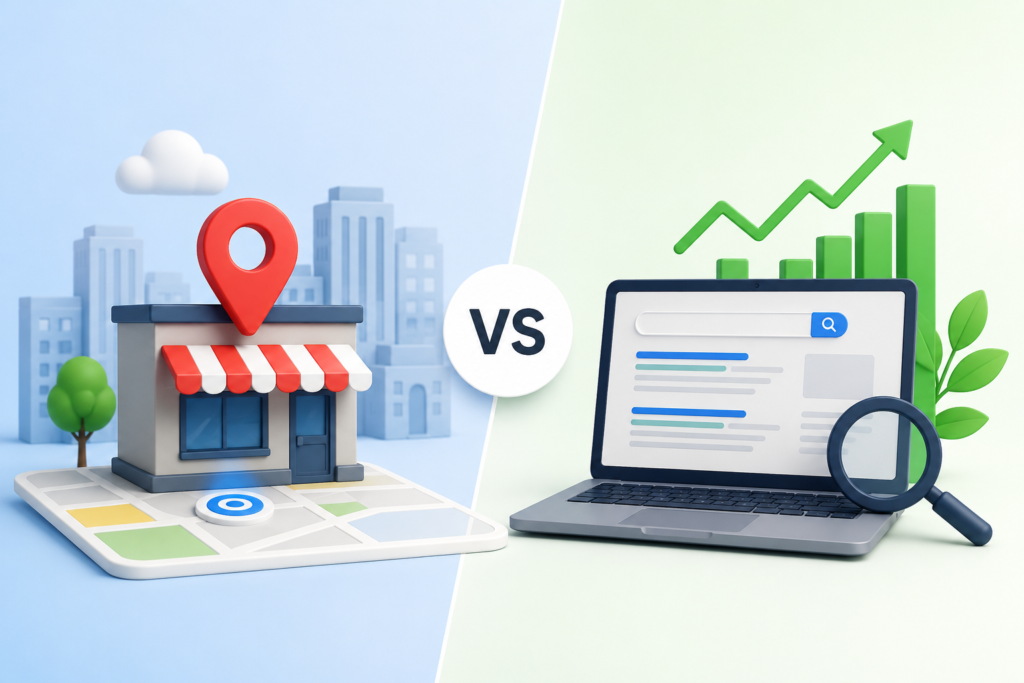
Which Is Better: Local SEO or Organic SEO?
Honestly? Neither is universally better. The right answer depends entirely on your business model.
Here is a simple way to think about it:
Choose local SEO as your priority if:
- You have a physical location customers visit
- You serve a specific city, region, or area
- Your customers search with local intent (“near me,” “in [city]”)
- You are a restaurant, clinic, salon, lawyer, contractor, or retail store
Choose organic SEO as your priority if:
- You operate online or nationally
- You sell products or services without geographic limits
- You want to build long-term brand authority through content
- You are a SaaS company, blogger, ecommerce store, or publisher
Do both if:
- You have a physical location AND an online product or service
- You want to capture both local buyers and broader digital audiences
- You are building a brand that needs awareness beyond your city
Most established businesses need both. A law firm, for example, benefits from local SEO to capture “divorce lawyer in [city]” searches AND from organic SEO to rank for informational content that builds credibility.
How Does the Keyword Strategy Differ?
The approach to keyword research changes significantly when you shift from local to organic strategy.
In organic SEO, you target informational, navigational, or transactional keywords with broader reach. You focus on search volume, competition, and intent. A keyword like “best project management tools” might get 20,000 monthly searches globally.
In local SEO, you target geo-modified keywords and near-me searches. “Project management consultant in Mumbai” may only get 200 monthly searches, but those 200 people are exactly your buyers. The conversion rate on hyper-local keywords tends to be significantly higher because the intent is so precise.
Semantic keywords matter in both. For local SEO, these include location-based terms, neighborhood names, and service-area language. For organic SEO, semantic coverage means addressing related topics, questions, and subtopics around your core subject.
What About Local Organic Rankings?
Here is something that trips people up: local organic rankings are different from Map Pack rankings.
Below the Map Pack, Google shows regular organic results, but these are often still influenced by location. A local business with strong on-page optimization and local backlinks can rank in the organic section below the Map Pack for local queries.
This means a business with a solid local SEO strategy can actually appear twice on the first page, once in the Map Pack and once in the organic results. That kind of visibility is a serious competitive advantage.


Does Organic SEO Help Local SEO (and Vice Versa)?
Yes, and this is one of the most underrated insights in this space.
Strong organic SEO lifts local SEO. A website with good domain authority, fast loading speed, and quality content sends positive trust signals that benefit local rankings too. Google does not operate in silos.
And local SEO can support organic efforts. Local backlinks, local content, and a well-reviewed Google Business Profile all contribute to overall domain signals. Reviews, for example, contain naturally occurring keywords that can influence relevance in search.
The two strategies are not competing. They are complementary. Running both together amplifies results in a way that neither can achieve alone.
Common Mistakes Businesses Make
Treating local and organic as identical: Using the same content strategy for both leads to mediocre results in both. They need tailored approaches.
Ignoring Google Business Profile: Many businesses still have unclaimed or outdated profiles. This is money left on the table for any business with a physical location.
Publishing content without local relevance: Writing generic blog posts when your target audience is in a specific city misses the local SEO opportunity completely. City-specific landing pages, locally relevant case studies, and community-focused content all strengthen local signals.
Chasing high-volume organic keywords too early: A new website competing for broad, high-volume keywords will struggle. Long-tail and locally targeted keywords offer faster wins with less competition.
Ignoring reviews: Review signals are among the most important local ranking factors. Businesses that do not actively encourage and respond to reviews lose ground to competitors who do.
How to Build a Combined Strategy That Works
You do not have to pick one and abandon the other. Here is a smart approach that covers both:
Step 1: Claim and optimize your Google Business Profile. Fill in every field. Add photos. Set your service areas. Post regularly. This is the foundation of local SEO.
Step 2: Fix your NAP consistency. Make sure your Name, Address, and Phone number are identical across every directory, social platform, and your website.
Step 3: Build location-specific pages on your website. If you serve multiple cities, create a dedicated page for each. Optimize them with locally relevant content, not copy-pasted boilerplate.
Step 4: Create organic content that answers real questions. Blog posts, guides, and comparison articles (like this one) build authority, attract backlinks, and educate your audience.
Step 5: Earn local backlinks. Sponsoring local events, getting listed in local directories, or being featured in regional publications all send strong local trust signals.
Step 6: Gather and manage reviews consistently. Ask happy customers to leave reviews on Google. Respond to every review, positive and negative. Google watches this.
Step 7: Track performance separately. Use Google Search Console and Google Analytics to monitor organic traffic. Use your Google Business Profile dashboard for local insights. Measure each channel on its own terms.
Frequently Asked Questions
What is the difference between local SEO and organic SEO?
Local SEO helps your business appear in Google’s Map Pack and location-based search results for nearby customers. Organic SEO improves your website’s visibility in standard search results regardless of where the searcher is located. Both use unpaid strategies, but they target different parts of the search results page and rely on different ranking signals.
Which is better: local SEO or organic SEO?
Neither is universally better — it depends on your business type. Local SEO is better for businesses with a physical location or service area, like restaurants, clinics, or contractors. Organic SEO is better for online businesses, ecommerce stores, and brands targeting a national or global audience. Most businesses with a physical location benefit from running both together.
Is local SEO part of organic SEO?
Yes, local SEO is a subset of organic SEO. Both involve unpaid rankings and share foundational tactics like keyword optimization and quality content. However, local SEO has an additional layer that includes Google Business Profile management, local citations, review signals, and proximity-based ranking factors that standard organic SEO does not use.
Does local SEO affect organic search rankings?
Yes, indirectly. A strong local SEO presence, including a well-optimized Google Business Profile, consistent local citations, and positive reviews, can improve your overall domain trust signals. This can positively influence your organic search rankings as well, since Google evaluates authority and credibility across all of your online presence.
How long does local SEO take compared to organic SEO?
Local SEO typically shows results faster. Businesses can see improvements in Map Pack visibility within 4 to 8 weeks with consistent Google Business Profile optimization and review activity. Organic SEO generally takes 3 to 6 months to build consistent rankings, depending on competition and website authority.
Can a business rank in both local SEO and organic SEO results at the same time?
Yes. A business can appear in Google’s Map Pack through its Google Business Profile while also ranking in the organic results below the Map Pack through its website. Appearing in both positions on the same search results page significantly increases visibility and click-through opportunities for the same search query.
What are the ranking factors for local SEO vs organic SEO?
Local SEO ranking factors include proximity to the searcher, Google Business Profile relevance, review quality and quantity, NAP consistency, and local citations. Organic SEO ranking factors include content quality and depth, backlinks from authoritative websites, technical SEO health, Core Web Vitals, and E-E-A-T signals. Google uses different algorithms for each type of result.
Do I need a website for local SEO?
You do not strictly need a website to appear in Google’s Map Pack, since Google Business Profile alone can get you ranked in local results. However, having a website strengthens your local SEO significantly by providing location-specific landing pages, structured data, and content that reinforces your geographic relevance and business authority.
Final Thoughts
The local SEO vs organic SEO conversation is not about picking a winner. It is about understanding what each does, where it excels, and how your business fits into that picture.
Local SEO wins you foot traffic, phone calls, and map visibility. Organic SEO wins you content authority, national reach, and compounding traffic over time. Both are legitimate growth channels. Both require consistent effort. And both, when done right, make each other stronger.
If your business has a physical presence, local SEO is not optional, it is urgent. If you want long-term brand visibility and traffic that does not depend on your zip code, organic SEO is your investment.
The smartest businesses do not debate which one is better. They build both, measure both, and grow through both.