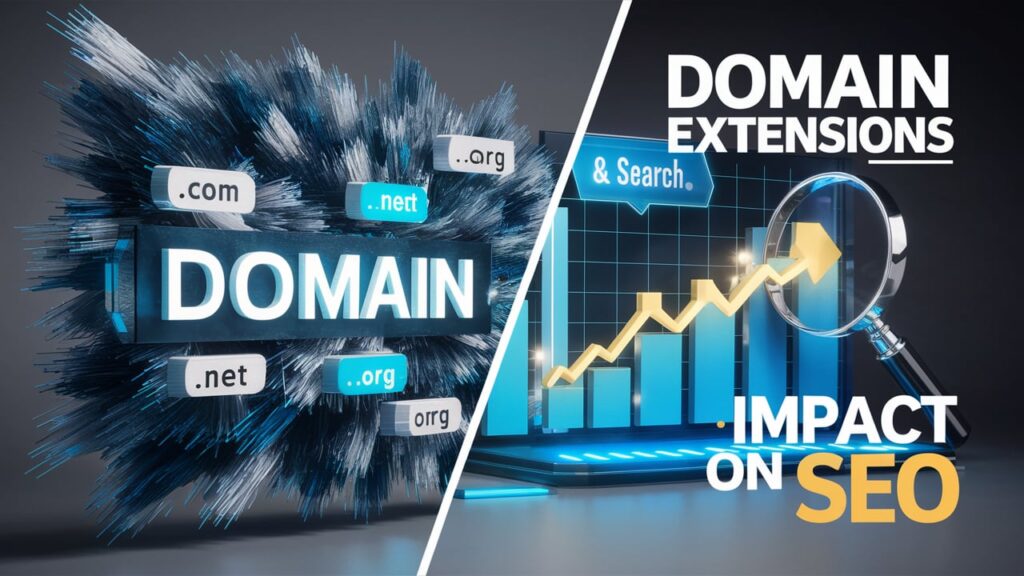
When you’re building a website, one of the first decisions you face is choosing a domain name. But here’s what most people overlook: the domain extension you pick can influence how search engines and users perceive your site. Understanding how domain extensions impact SEO is not just a technical detail. It is a foundational decision that shapes your website’s authority, trust, and long-term search visibility.
Let’s break this down properly, without the fluff.
What Is a Domain Extension, Exactly?
A domain extension, also called a Top-Level Domain (TLD), is the part that comes after the dot in your web address. Think .com, .org, .net, .in, or newer ones like .tech and .store.
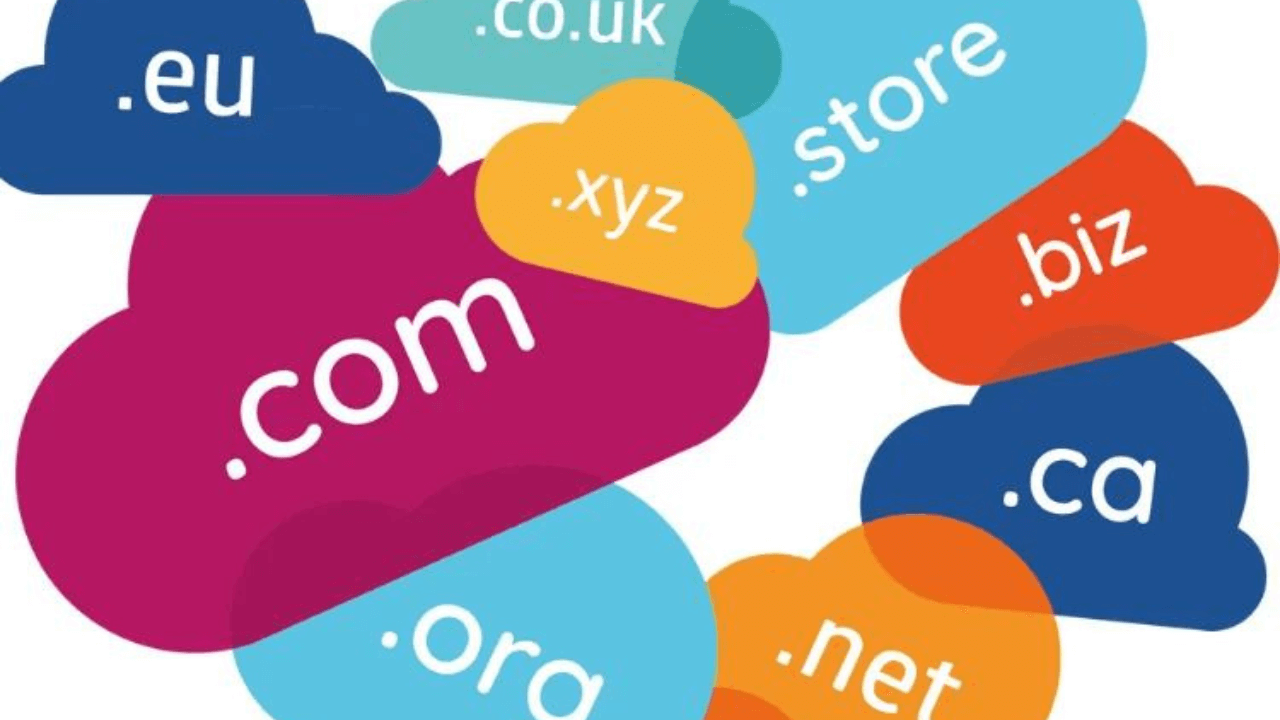
Google’s algorithms look at hundreds of signals when ranking websites. Your domain extension is one of those signals. Not the most powerful one, but definitely not something you should ignore either.
The internet currently has over 1,500 TLD options registered through ICANN. That is a lot of choices, and each carries different weight in terms of trust, familiarity, and domain extension SEO implications.
Does Domain Extension Affect SEO Directly?
This is probably the most searched question in this space, and the honest answer is: it depends.
Google has officially stated that most generic TLDs are treated equally in search rankings. So a .net site is not automatically ranked below a .com site, all else being equal. However, “all else being equal” is doing a lot of work in that sentence.
Here is what actually matters:
User trust plays a huge role. If someone sees a .com vs a .xyz, they are more likely to click on .com. Higher click-through rate signals relevance to Google. That indirectly affects rankings.
Brand familiarity also matters. People default to typing .com. If your site is .net and a competitor owns the .com, you might be sending traffic to them without even knowing it.


The .com Advantage: Why It Still Dominates
When it comes to .com vs .net SEO debates, .com wins on perception, not necessarily on raw algorithmic power.
.com represents about 54% of all registered domain names globally, according to data tracked by Verisign. That level of market dominance is not accidental. It is the default extension users trust, remember, and type.
From an SEO standpoint, .com domains tend to attract more backlinks naturally, simply because publishers link to them by habit. More backlinks mean stronger domain authority. Stronger authority means better rankings.
That said, a .net or .org site with superior content and proper SEO fundamentals can absolutely outrank a .com. The extension is not a magic shortcut.
Are Country Domain Extensions Good or Bad for SEO?
Country code TLDs (ccTLDs) like .in, .uk, .ca, or .au tell Google something very specific: this website is targeted at users in that country.
This is called geo-targeting, and Google uses ccTLDs as a strong signal for local search rankings.
If you run a business in India and your primary audience is Indian users, a .in domain can help you rank better in Indian search results. Google’s Search Console even allows you to set geographic targets, but a ccTLD does that automatically.
The trade-off? Country domain extensions limit your global reach. If you ever want to expand internationally, a ccTLD can become a limitation rather than an asset.
How Do New Domain Extensions Affect SEO?
The rise of new domain extensions like .tech, .store, .blog, .agency, and hundreds of others has created genuine confusion.
Here is the truth about new domain extensions and SEO: Google treats them the same as generic TLDs like .com and .net, from a technical standpoint.
However, from a user trust and brand recognition perspective, they are still building credibility. A .tech domain for a technology company can actually be more descriptive and memorable than a generic .com name. That specificity can improve click-through rates in search results.
The downside is that some spam-heavy TLDs have earned poor reputations with both users and spam filters. Spammers historically gravitated toward cheap, new extensions. If your chosen TLD has been heavily abused, that history can work against you.

What Does Google Actually Say About TLDs and Rankings?
Google’s official stance, repeated by John Mueller in multiple Google Search Central discussions, is that the domain extension itself is not a direct ranking factor.
However, Mueller has also clarified that certain extensions carry contextual signals. A .gov or .edu domain carries inherent trust signals simply because of who is allowed to register them. A .edu site cannot be registered by just anyone, which is why backlinks from .edu domains carry significant weight in SEO analysis.
The practical takeaway: focus on building content authority, earning backlinks, and improving user experience. Your TLD supports those efforts but does not replace them.
Is .org Better Than .com for SEO?
Not inherently. But .org carries a strong trust signal in specific contexts.
.org was originally intended for non-profit organizations. While anyone can now register a .org domain, users still associate it with credibility, public interest organizations, and non-commercial intent.
If your website is a community resource, an educational platform, or a non-profit, .org can actually increase perceived credibility. That perception translates into better engagement metrics, which are behavioral signals that Google monitors.
For commercial websites, .com remains the stronger choice from a conversion and trust perspective.
How Does Your Domain Extension Affect Local SEO?
Local SEO is one area where the impact of TLD on SEO becomes very tangible.
If you use a ccTLD, Google automatically associates your site with that country. This gives you an immediate local relevance boost without needing to configure geographic settings manually.
If you use a .com but want to target a specific region, you need to do more work: set up Google Search Console geo-targeting, use local structured data, build local backlinks, and make location signals clear throughout your content.
For pure local businesses serving one country, a ccTLD can simplify your local SEO strategy significantly.

Can a Bad Domain Extension Hurt Your SEO?
Yes, actually. Not because Google penalizes the extension itself, but because of associations.
Certain TLDs have historically been associated with spam, phishing, and low-quality websites. Extensions like .xyz, .top, .club, and .loan have, at various points, topped spam domain lists tracked by cybersecurity researchers.
If your legitimate business happens to use one of these extensions, you may face an uphill battle in building user trust. Email deliverability can also suffer. Some spam filters flag entire TLDs based on historical abuse patterns.
The lesson: cheap does not always mean smart. The few dollars you save on a low-trust TLD could cost you significantly in conversion rates and user trust signals.
What Are the Best Domain Extensions for SEO?
Here is a practical breakdown based on use case:
For general commercial websites: .com remains the gold standard. It is universally trusted, easy to remember, and carries the broadest brand recognition.
For country-specific businesses: Use your relevant ccTLD. A .in for India, .uk for the United Kingdom. This simplifies your local SEO and geo-targeting.
For non-profits and communities: .org carries natural credibility signals that align with non-commercial intent.
For tech and startup brands: .io has become widely accepted in the tech industry. It is perceived as modern and credible within that space. Similarly, .tech and .app can work well when used by relevant brands.
For e-commerce businesses: .com or .store are both viable. .store is descriptive and increasingly common for online retail brands.
Does Keyword in Domain Extension Help SEO?
Not in the way it used to. Google’s 2012 update significantly reduced the ranking advantage of exact match domains (EMDs).
So having bestshoesstore.com no longer guarantees you rank for “best shoes store.” However, it still helps with user recognition and click-through rates. People see a relevant domain name in search results and are more likely to trust it as an authoritative source.
The keyword should ideally appear naturally in your domain name, not be forced. A clean, brandable domain that contains a relevant keyword still holds value in terms of user trust, even if the direct SEO juice from keyword-in-domain is minimal today.
What Are SEO Friendly Domain Extensions in 2026?
SEO-friendly domain extensions share some common traits. They are widely recognized, not associated with spam, and either universally trusted or specifically relevant to their industry.
The most consistently safe options are .com, .org, .net, .co, and your relevant ccTLD.
Niche extensions like .io, .ai, .tech, .app, and .dev have earned strong reputations in the technology sector. Google themselves registered Google.app. That kind of adoption from major brands signals that these extensions are credible choices.
The key consideration with any domain extension for SEO is whether it supports your brand positioning and builds user trust. Search engines respond to user behavior. If users trust your domain and engage with your content, rankings follow.
Domain Name SEO Tips Beyond Just the Extension
While extension matters, the full domain name strategy goes deeper.
Keep it short and simple. Shorter domains are easier to remember, type, and share. Fewer characters also mean less risk of typos.
Avoid hyphens. Hyphenated domains are historically associated with spam. They also look less professional and are harder to say aloud.
Make it brandable. A unique, memorable name builds brand recall. Brand recall drives direct traffic. Direct traffic is a strong quality signal for Google.
Avoid numbers. Numbers create confusion. Is it the numeral “4” or the word “four”? Ambiguity hurts brand recognition.
Secure your primary variations. If you launch on .com, consider also registering .net and your country’s ccTLD to prevent competitors or squatters from snapping them up.
How Search Engines Crawl and Interpret TLDs
Google’s crawlers treat all generic TLDs equally during indexing. The search algorithm does not assign a ranking bonus or penalty based solely on the extension.
What the algorithm does evaluate is the totality of signals associated with that domain: backlink profile, content quality, site speed, user engagement, E-E-A-T signals (Experience, Expertise, Authoritativeness, and Trustworthiness), and historical behavior.
A domain that has been registered for years, built up quality backlinks, and served users well will outrank a fresh .com with no history. Domain age and authority accumulate over time regardless of the extension.
Should You Switch Domain Extensions If You Already Have One?
If you are currently ranking well and have an established domain, switching extensions is almost never worth the risk. Domain migrations are one of the most disruptive things you can do to your SEO.
When you migrate a domain, even perfectly executed with 301 redirects, you typically see a ranking dip that can take months to recover from. You lose the trust and authority that your old domain had built up.
The only scenarios where switching might make sense: you are rebranding entirely, moving from a country-specific TLD to target a global audience, or your current extension is genuinely harming your brand’s credibility in the market.
Even then, plan the migration meticulously and give yourself a 6 to 12 month recovery window.
Frequently Asked Questions
Is .com better for SEO than other domain extensions?
A .com domain is not inherently better for SEO, but it is often perceived as more trustworthy and familiar, which can improve user clicks and brand credibility. Higher CTR may indirectly support SEO performance.
Do country-code domains (ccTLDs) help local SEO?
Yes, country-code domains like .uk, .in, or .ca can help signal geographic relevance to search engines, making them useful for businesses targeting specific countries.
Does Google treat all domain extensions equally?
Google generally treats generic top-level domains (gTLDs) like .com, .net, .org, and newer extensions such as .tech or .store equally in rankings. Content quality and backlinks matter more.
Are newer domain extensions like .ai or .io bad for SEO?
No, newer domain extensions are not bad for SEO. Domains like .ai and .io can rank well if they have strong content, technical SEO, and quality backlinks.
Is .co bad for SEO compared to .com?
No, .co is not bad for SEO. However, users may accidentally type .com instead, which can affect direct traffic and brand recall.
What is the best domain extension for SEO?
There is no single “best” domain extension for SEO. The best choice depends on your audience, branding, and target market. For global businesses, .com is often preferred, while ccTLDs may work better for local SEO.
Can changing a domain extension hurt SEO?
Yes, changing a domain extension can temporarily impact rankings if redirects are not implemented properly. Using 301 redirects and updating internal links can help preserve SEO value.
Does a keyword domain extension improve rankings?
Having keywords in a domain extension does not guarantee better rankings. Google prioritizes relevance, content quality, and authority over exact-match domains.
Should I choose .com, .org, .net, or a new TLD?
Choose a domain extension based on brand trust, audience expectations, and business goals. .com is widely trusted, .org suits nonprofits, and niche TLDs can help branding.
The Bottom Line on Domain Extension SEO
The impact of domain extensions on SEO is real but nuanced. Your TLD does not directly control your rankings, but it influences user trust, click-through rates, local relevance, and brand perception. All of those factors feed into how search engines evaluate your site.
Choose .com when you can get a clean, brandable name. Use a ccTLD when local dominance is your primary goal. Consider niche extensions only when they genuinely align with your brand and industry.
More importantly, remember that no domain extension compensates for poor content, weak backlinks, or a bad user experience. The extension is your first impression. What you build on top of it is what actually wins in search.
Get the extension right, then focus relentlessly on the stuff that moves the needle: content quality, technical SEO, link building, and user satisfaction.
That is how you win, regardless of what comes after the dot.