Every day, thousands of people search for legitimate ways to make money online. Maybe you’ve watched a YouTube video where someone casually mentioned a product link in their description. Or maybe you’ve read a blog that recommended a software tool and wondered how the writer earns from it. The online income space has exploded in recent years, and two of the biggest models driving that growth are affiliate marketing vs influencer marketing.
- Affiliate Marketing vs Influencer Marketing: Quick Answer
- Affiliate Marketing vs Influencer Marketing: Full Comparison Table
- What Is Affiliate Marketing?
- How It Works
- Popular Affiliate Networks
- Advantages of Affiliate Marketing
- Challenges of Affiliate Marketing
- Real-World Example
- What Is Influencer Marketing?
- How It Works
- Major Platforms for Influencer Marketing
- Advantages of Influencer Marketing
- Challenges of Influencer Marketing
- Real-World Example
- Affiliate Marketing vs Influencer Marketing: Key Differences
- Startup Costs
- Revenue Model
- Required Skills
- Audience Building
- Scalability
- Time Commitment
- Risk and Stability
- Long-Term Growth
- Passive Income Potential
- Brand Dependency
- Content Requirements
- ROI Potential
- Affiliate Marketing: Pros and Cons
- Pros
- Cons
- Influencer Marketing: Pros and Cons
- Pros
- Cons
- Which Is Better for Beginners?
- Limited Budget Scenario
- No Audience Scenario
- For Students
- For Freelancers
- For Bloggers
- Which Generates More Income?
- Short-Term Earning Potential
- Long-Term Earning Potential
- Passive Income
- Scaling Opportunities
- Can You Combine Affiliate Marketing and Influencer Marketing?
- The Hybrid Business Model
- Best Strategies for Combining Both
- Real-Life Use Case
- Real-Life Examples
- The Blogger – Niche Site Success
- The YouTuber – Hybrid Creator
- The Instagram Creator – Beauty Micro-Influencer
- The Niche Website Owner – Authority Site
- Expert Verdict
- Choose Affiliate Marketing When:
- Choose Influencer Marketing When:
- Choose Both When:
- Frequently Asked Questions (FAQ)
- Is affiliate marketing better than influencer marketing?
- Can beginners start affiliate marketing?
- Which business model makes more money?
- Do influencers use affiliate marketing?
- Is affiliate marketing still profitable in 2026?
- How many followers do you need for influencer marketing?
- Can I do affiliate marketing without social media?
- Which model is easier to scale?
- How long does it take to make money with affiliate marketing?
- Which is better for passive income – affiliate or influencer marketing?
- Can you start influencer marketing with no followers?
- Conclusion
Both paths promise income. Both live in the digital space. And both confuse beginners almost equally.
So what’s actually the difference? Which one is easier to start? Which one pays more? And can you realistically build a business around either of them without a big following or a massive budget?
That’s exactly what this guide is designed to answer.
Whether you’re a student exploring online income ideas, a blogger looking to monetize your content, a freelancer considering a pivot, or an entrepreneur building your first digital business – this article breaks down everything you need to know about affiliate marketing and influencer marketing.
By the time you finish reading, you’ll know which model fits your skills, budget, and long-term goals. No hype, no fluff – just a clear, honest comparison to help you make the right decision.
Let’s get into it.
Affiliate Marketing vs Influencer Marketing: Quick Answer
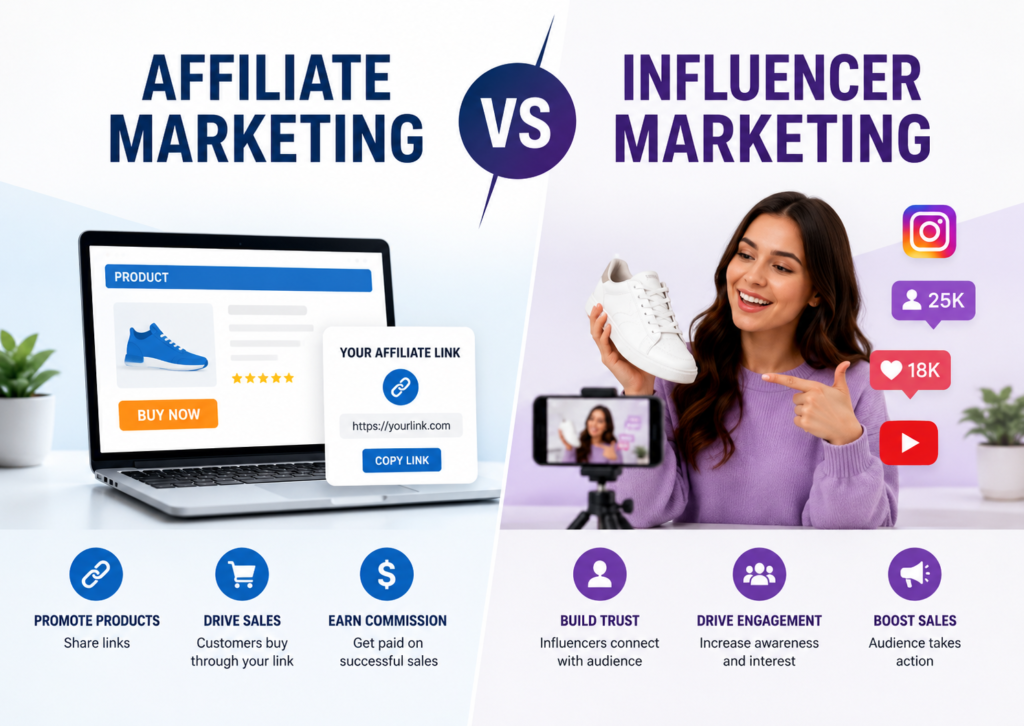
Affiliate marketing is a performance-based model where you earn commissions by promoting other brands’ products through trackable links. Influencer marketing involves building a social media audience and getting paid by brands for sponsored content. Affiliate marketing offers better passive income potential; influencer marketing delivers faster brand deals. Both can be combined for maximum results.
Affiliate Marketing vs Influencer Marketing: Full Comparison Table
| Feature | Affiliate Marketing | Influencer Marketing |
|---|---|---|
| Definition | Earn commissions by promoting products via unique links | Get paid by brands to create sponsored content for your audience |
| Startup Cost | Very low ($0–$100 to start) | Low to moderate (equipment, content tools) |
| Income Potential | Moderate to very high (scalable) | Moderate to very high (audience-dependent) |
| Skill Requirements | SEO, content writing, email marketing, analytics | Video/photo creation, storytelling, audience engagement |
| Scalability | Highly scalable (automation possible) | Moderately scalable (time-intensive) |
| Time to First Results | 3–12 months (organic) or days (paid traffic) | Weeks to months |
| Audience Requirement | No existing audience required | Active, engaged audience essential |
| Risk Level | Low to moderate | Low to moderate |
| Passive Income Potential | Very high | Low to moderate |
| Brand Dependence | Moderate (multiple programs available) | High (reliant on brand partnerships) |
| Content Creation Requirement | Moderate (blog posts, email, YouTube) | High (consistent daily/weekly posting) |
| Long-Term Sustainability | Very high (SEO, email assets) | Moderate (algorithm-dependent) |
| Best For | Bloggers, SEO writers, niche site builders, introverts | Social media creators, videographers, community builders |
What Is Affiliate Marketing?
Affiliate marketing is a performance-based digital marketing model. You promote someone else’s product or service using a unique tracking link. When someone clicks that link and makes a purchase (or completes a specific action), you earn a commission. That’s it.
You don’t create the product. You don’t handle shipping or customer support. Your job is to connect the right audience to the right product and earn a percentage of every successful referral.
How It Works
The affiliate marketing process follows a simple chain:
- You join an affiliate program — Amazon Associates, ShareASale, CJ Affiliate, Impact, or a brand’s own program.
- You receive a unique tracking link — this link identifies your referrals.
- You promote the product — through a blog, YouTube channel, email newsletter, or social media post.
- A visitor clicks your link and buys — the sale is tracked back to you.
- You earn a commission — anywhere from 1% to 75% depending on the program.
Popular Affiliate Networks
- Amazon Associates — massive product variety, low commissions (1–10%)
- ShareASale — thousands of merchant programs across many niches
- CJ Affiliate (Commission Junction) — enterprise-level brands and partnerships
- Impact — popular with SaaS and premium brands
- ClickBank — digital products, often higher commissions (30–75%)
- Rakuten Advertising — trusted global affiliate network
Advantages of Affiliate Marketing
- No product creation required
- Extremely low startup costs
- Strong passive income potential through evergreen content
- Works 24/7 – content keeps earning while you sleep
- Can be built without showing your face or having a social following
- Multiple income streams from different programs simultaneously
Challenges of Affiliate Marketing
- Takes time to build organic traffic (especially SEO-based)
- Programs can change commission rates or shut down
- High competition in popular niches
- Requires consistent content creation and strategy
- Initial income can be slow – patience is non-negotiable
Real-World Example
A blogger runs a niche website about home coffee brewing equipment. They publish detailed reviews and comparison posts. Each article includes Amazon affiliate links and links to specialty coffee brands. With solid SEO, the site attracts 50,000 monthly visitors. Even with a 2–3% conversion rate and average commissions of $15–20 per sale, that’s a meaningful monthly income – all from content written months or years ago.
What Is Influencer Marketing?
Influencer marketing is a form of social media marketing where individuals with established audiences – called influencers – partner with brands to promote products or services. Unlike affiliate marketing, which is commission-driven, influencer marketing typically involves direct brand deals, flat-fee payments, free products, or sponsored content agreements.
The key ingredient is audience trust. Influencers succeed because their followers genuinely value their recommendations.
How It Works
- You build an engaged audience on a platform (Instagram, YouTube, TikTok, X, LinkedIn, etc.)
- Brands reach out (or you pitch brands) for partnerships
- You create sponsored content — a post, reel, video, story, or newsletter mention
- The brand pays you — either a flat fee, free product, or commission-based deal
- You disclose the partnership — transparency and FTC compliance are mandatory
Major Platforms for Influencer Marketing
- Instagram — fashion, beauty, lifestyle, fitness
- YouTube — long-form reviews, tutorials, vlogs
- TikTok — short-form viral content, younger audiences
- LinkedIn — B2B, professional services, SaaS
- X (Twitter) — tech, finance, opinion leaders
- Pinterest — home décor, recipes, DIY
Advantages of Influencer Marketing
- Faster path to brand deals once you have an audience
- Potential for high flat-fee payments per post or campaign
- Builds personal brand and long-term authority
- Creates multiple income streams (sponsorships, merchandise, courses)
- More creative freedom in content style and presentation
- Community building leads to strong audience loyalty
Challenges of Influencer Marketing
- Building a loyal audience takes significant time and effort
- Income is inconsistent – brand deals come and go
- Platform algorithm changes can tank your reach overnight
- Requires constant content creation to stay relevant
- May need investment in cameras, lighting, editing software
- Follower count alone doesn’t guarantee income – engagement matters more
Real-World Example
A fitness creator on Instagram grows their account to 45,000 followers over 18 months by posting workout tips, meal prep ideas, and personal transformation content. A protein supplement brand reaches out and offers $800 for a dedicated reel. As the account grows to 100,000 followers, deals range from $1,500 to $5,000 per post. Meanwhile, they also add affiliate links to their bio – creating a hybrid income model.
Affiliate Marketing vs Influencer Marketing: Key Differences
Startup Costs
Affiliate marketing is arguably the most beginner-friendly model in terms of cost. You can start a blog using a free platform like WordPress.com or invest around $50–$100 for hosting and a domain. Most affiliate programs are free to join. Your main investment is time.
Influencer marketing has a similar low-cost entry point, but creating quality content often requires a decent smartphone camera, ring light, and editing apps. As you scale, production costs can increase – though many successful influencers started with just a phone and natural lighting.
Winner for beginners with no budget: Affiliate Marketing
Revenue Model
This is where the two paths genuinely diverge.
Affiliate marketing is performance-based — you only earn when someone takes action (purchase, sign-up, free trial, etc.). There’s no guaranteed income, but once content ranks and converts, it generates passive revenue with little ongoing effort.
Influencer marketing is typically relationship-based — brands pay you for access to your audience, regardless of whether followers actually buy anything. A flat-fee post pays the same whether 100 or 10,000 people click the link.
Required Skills
Affiliate marketing rewards people who enjoy writing, research, SEO, email marketing, and data analysis. It’s a behind-the-scenes model where your personality doesn’t need to be front and center.
Influencer marketing is built on personality, storytelling, video/photo skills, and community engagement. You need to show up consistently, respond to comments, and maintain audience relationships.
Audience Building
Here’s an important truth many beginners miss: affiliate marketing doesn’t require an existing audience.
You can build a niche website, optimize it for search engines, and attract thousands of monthly visitors – all without a single social media follower.
Influencer marketing, by contrast, lives and dies by audience size and engagement. Without followers, there are no brand deals. Building that audience is the entire job – at least in the beginning.
Scalability
Affiliate marketing scales beautifully. Once you create a well-optimized blog post or YouTube review, it can attract traffic and generate commissions for years. You can run multiple niche sites, promote dozens of affiliate programs simultaneously, and even outsource content creation once you have revenue to reinvest.
Influencer marketing scales with effort. More followers unlock bigger deals, but the content treadmill never really stops. Your income is tied to your output – if you stop posting, brand deals dry up.
Time Commitment
Affiliate marketing (especially SEO-driven) requires heavy upfront effort but allows for a more flexible schedule once content is published and ranking. Email marketing and evergreen content do most of the heavy lifting.
Influencer marketing demands consistent, often daily content output. The platforms reward frequency and engagement. Burnout is a real risk for creators who don’t manage their workflow carefully.
Risk and Stability
Both models carry risk, but in different forms.
- Affiliate marketers face SEO algorithm updates (Google’s core updates can tank a site’s traffic overnight) and program policy changes (Amazon has cut commissions multiple times).
- Influencers face platform algorithm shifts, brand deal volatility, and cancel culture risks that can damage their reputation and income almost instantly.
Diversification is the antidote in both cases.
Long-Term Growth
Affiliate marketing assets – a well-built website, an email list, a YouTube channel – have genuine long-term value. They can be sold, licensed, or monetized in multiple ways. Some affiliate sites have been sold for 30–40x monthly revenue.
Influencer accounts are harder to monetize independently of the creator. Your personal brand is your business, which creates both opportunity and limitation.
Passive Income Potential
This category strongly favors affiliate marketing. A blog post written today can continue earning commissions three years from now if it maintains search rankings. Email sequences deliver promotions automatically. Comparison articles and product reviews are evergreen assets.
Influencer income requires the influencer to stay active. There are exceptions – YouTube videos can generate ad revenue passively, and affiliate links in video descriptions keep working – but generally, the income stops when the content stops.
Brand Dependency
Affiliate marketers can promote hundreds of products across multiple networks. Losing one program hurts, but it rarely devastates the business.
Influencers often rely on a small pool of brand partners for a significant portion of their income. Losing a major brand deal – or getting dropped from a partnership – can create serious financial disruption.
Content Requirements
Affiliate marketing requires consistent, high-quality long-form content (blog posts, YouTube reviews, email newsletters). Once created, that content works independently.
Influencer marketing requires ongoing, high-frequency content creation. Short-form content on TikTok or Instagram Stories has an extremely short lifespan – often less than 48 hours.
ROI Potential
Both models offer strong ROI, but measured differently. Affiliate marketers measure ROI by commission earned vs. content creation cost. Influencers measure it by deal value vs. time and equipment invested. High-ticket affiliate programs (SaaS, finance, web hosting) can deliver $100–$500+ per single conversion – making ROI exceptional with relatively modest traffic.
Affiliate Marketing: Pros and Cons
Pros
- Low startup cost – start with almost no money
- Passive income potential through evergreen content
- No product creation, inventory, or customer support
- Scalable across multiple niches and programs
- Introverts can succeed without showing face or building a personal brand
- Flexible schedule – work from anywhere
- Multiple income streams from different affiliate programs
- Long-term asset building (websites, email lists)
Cons
- Slow initial results – organic SEO takes months to gain traction
- Commission rates can be cut without warning
- High competition in popular niches (finance, health, software)
- Requires ongoing SEO maintenance and content updates
- Google algorithm updates can disrupt traffic significantly
- Conversion is not guaranteed – clicks don’t always lead to sales
Influencer Marketing: Pros and Cons
Pros
- Faster path to brand partnerships once audience is established
- High earning potential per post for large accounts
- Creative freedom in content style and format
- Strong community and audience loyalty drives long-term opportunities
- Opens doors to merchandise, courses, speaking, and books
- Personal brand becomes a versatile business asset
- Micro-influencers (10K–50K followers) are increasingly in demand
Cons
- Requires significant time investment to build an audience
- Income inconsistency – brand deals fluctuate seasonally
- Platform dependency creates vulnerability to algorithm changes
- Content burnout is a genuine challenge for long-term creators
- Follower count without engagement delivers poor brand results
- Starting with zero followers is a slow, often discouraging process
Which Is Better for Beginners?
This question deserves an honest answer, not a vague “it depends.”
Limited Budget Scenario
If you’re starting with under $100, affiliate marketing is your best first move. You can launch a blog, join free affiliate programs, and start producing content without any significant financial investment. Building a social media following from scratch also costs nothing financially, but it demands enormous time and energy with uncertain returns.
No Audience Scenario
Affiliate marketing wins here too. You don’t need a single follower to start. A niche website targeting long-tail keywords can rank on Google and attract thousands of monthly visitors before you ever touch social media.
For Students
Students often have time but limited money. Affiliate marketing is ideal – start a blog around a topic you’re already studying or passionate about, add affiliate links naturally, and build your SEO skills simultaneously. Those SEO skills are also highly marketable.
For Freelancers
Freelancers who already create content – writers, videographers, designers – can integrate affiliate marketing into their existing workflow. A freelance writer can start a niche blog with minimal additional effort. A videographer can build a YouTube channel around their expertise and add affiliate links.
For Bloggers
Bloggers are in the perfect position to combine both models. Use affiliate links within your content (affiliate marketing) and pitch brands for sponsored posts as your audience grows (influencer marketing). This hybrid approach maximizes revenue from a single piece of content.
Bottom line for beginners: Start with affiliate marketing. Build your skills, earn your first commissions, and grow your audience simultaneously. Influencer marketing becomes increasingly viable as your platform grows.
Which Generates More Income?
Let’s look at realistic numbers – not fantasy income screenshots, but genuine earning ranges.
Short-Term Earning Potential
- Affiliate marketing: Expect little to no income in the first 3–6 months if relying on SEO. With paid traffic, results can come faster but require ad spend.
- Influencer marketing: A micro-influencer with 10,000–20,000 engaged followers can land their first paid brand deal within weeks to months of actively pitching.
Short-term edge: Influencer marketing
Long-Term Earning Potential
- Affiliate marketer with a well-built niche site: $2,000–$20,000+/month is realistic after 2–3 years of consistent effort
- Full-time influencer with 100,000–500,000 followers: $5,000–$50,000+/month from brand deals, affiliate commissions, and digital products
Both models can generate full-time income. The key variable is consistency and strategy.
Passive Income
Affiliate marketing dominates here. A single well-ranked blog post or YouTube video can generate commissions for years with zero maintenance. Influencer income requires ongoing active participation.
Scaling Opportunities
An affiliate marketer can scale by building multiple niche sites, growing an email list of 50,000+ subscribers, or launching a YouTube channel alongside their blog. Each new channel compounds revenue.
An influencer scales by growing their following and diversifying income – adding courses, merchandise, speaking engagements, or their own products.
Can You Combine Affiliate Marketing and Influencer Marketing?
Absolutely – and this is honestly where the biggest online income opportunity lives in 2026.
The Hybrid Business Model
The smartest content creators don’t choose one model. They stack both.
Here’s what a hybrid model looks like in practice:
- You build a YouTube channel (influencer side) and a companion blog (affiliate side)
- Your YouTube videos drive viewers to your blog for detailed reviews
- Your blog posts are optimized for Google and include affiliate links
- Brands reach out for YouTube sponsorships based on your subscriber count
- Your email list gets affiliate promotions automatically
- Your YouTube video descriptions include affiliate links that earn passively
Every piece of content works multiple income angles simultaneously.
Best Strategies for Combining Both
- Add affiliate links to influencer content — include trackable links in every Instagram bio, YouTube description, or TikTok profile
- Use sponsored content to drive traffic — send brand deal traffic to your blog or landing page to capture emails
- Build an email list from your social audience — email is platform-independent and allows ongoing affiliate promotions
- Create comparison content — “Brand A vs Brand B” posts work brilliantly for both SEO and social sharing
- Leverage affiliate programs from brand partners — many brands you get sponsored by also run affiliate programs. Do both.
Real-Life Use Case
A personal finance creator on YouTube with 75,000 subscribers creates a detailed video about the best budgeting apps. The video includes a sponsored segment from one app (influencer deal) and affiliate links to three other apps in the description. The companion blog post ranks on Google for “best budgeting apps” and earns additional affiliate commissions. One piece of content generates three separate revenue streams.
This is the creator economy at its most efficient.
Real-Life Examples
The Blogger – Niche Site Success
Sarah runs a niche site focused on pet care for small dogs. She publishes 3–4 articles per week – reviews, how-to guides, and product roundups. Using Amazon Associates and a pet supplement affiliate program, she earns $3,200/month passively after 18 months of consistent publishing. She never appears on camera and has no social following. Pure affiliate marketing.
The YouTuber – Hybrid Creator
Marcus runs a tech YouTube channel with 120,000 subscribers. He earns $4,000/month from YouTube AdSense, $3,500/month from brand deals (influencer), and $2,200/month from affiliate links in video descriptions. Total: nearly $10,000/month by combining both models effectively.
The Instagram Creator – Beauty Micro-Influencer
Priya has 38,000 Instagram followers in the beauty and skincare space. She earns $600–$1,200 per sponsored post and earns an additional $400–$800/month from affiliate links shared in Stories and her link-in-bio page. Her content is time-intensive, but brand deals are consistent thanks to her 6.5% engagement rate.
The Niche Website Owner – Authority Site
James built an authority site in the outdoor/hiking niche over three years. He ranks for hundreds of long-tail keywords and earns $12,000/month through a combination of affiliate commissions, display ads, and an email list of 22,000 subscribers. He’s never had a brand deal and never wanted one.
Expert Verdict
After examining both models across every major dimension, here’s the clearest, most honest verdict we can offer:
Choose Affiliate Marketing When:
- You prefer a content-first, behind-the-scenes business model
- You want passive income that earns while you sleep
- You don’t have (or don’t want) a social media presence
- You’re patient and willing to invest 6–12 months before significant earnings
- You’re interested in building a sellable digital asset
Choose Influencer Marketing When:
- You enjoy being in front of the camera and building a community
- You want to monetize an existing following or audience
- You’re comfortable with brand relationships and negotiations
- You want faster initial income through direct brand deals
- Your goal is personal brand recognition alongside income
Choose Both When:
- You want to maximize revenue from every piece of content you create
- You’re building a long-term digital media business
- You want income diversification and reduced platform dependency
- You’re serious about the creator economy as a career
The truth is this: the creators earning the most in 2026 aren’t choosing one model. They’re combining both – using influencer reach to grow audiences faster, and affiliate marketing to generate scalable, passive income from those same audiences.
Frequently Asked Questions (FAQ)
Is affiliate marketing better than influencer marketing?
Neither model is universally better – it depends on your skills and goals. Affiliate marketing offers stronger passive income and scalability. Influencer marketing offers faster brand deals and personal brand growth. Many successful creators combine both for maximum results.
Can beginners start affiliate marketing?
Yes, absolutely. Affiliate marketing is one of the most beginner-friendly online business models. You can start with zero investment by creating a free blog or YouTube channel, joining free affiliate programs like Amazon Associates, and publishing helpful content. Results take time, but the barrier to entry is genuinely low.
Which business model makes more money?
Both can generate significant income. Affiliate marketing can produce $5,000–$20,000+/month through niche sites and SEO with strong passive potential. Influencer marketing can earn $5,000–$50,000+/month for large creators through brand deals. Combining both models typically produces the highest overall earnings.
Do influencers use affiliate marketing?
Yes, and many of the most successful influencers rely heavily on affiliate income. Adding affiliate links to YouTube descriptions, Instagram bio link pages, and TikTok profiles allows influencers to earn performance-based income on top of their flat-fee brand deals.
Is affiliate marketing still profitable in 2026?
Yes, very much so. While competition has increased, the total volume of affiliate marketing spending continues to grow globally. High-ticket niches like SaaS, finance, and online education offer particularly strong commission rates. Quality content and smart SEO still deliver excellent returns.
How many followers do you need for influencer marketing?
There is no minimum threshold. Micro-influencers with 5,000–20,000 followers regularly land brand deals, especially with high engagement rates. Many brands now prefer micro-influencers over mega-influencers because their audiences are more targeted and trust levels are higher.
Can I do affiliate marketing without social media?
Yes. Many of the highest-earning affiliate marketers operate entirely through blogs and email newsletters without any social media presence. SEO-driven niche websites and YouTube channels are the most common social-media-free affiliate marketing channels.
Which model is easier to scale?
Affiliate marketing scales more easily and passively. Once content is published and ranking, it continues generating income without requiring your direct involvement. Influencer income scales with audience growth, but the content creation requirement never disappears.
How long does it take to make money with affiliate marketing?
With an SEO-focused blog, expect 3–12 months before meaningful traffic and income. With a YouTube channel, 6–18 months is typical. Using paid traffic methods, results can come faster but require ad spend. Patience and consistency are critical in the early stages.
Which is better for passive income – affiliate or influencer marketing?
Affiliate marketing is significantly better for passive income. Evergreen content (blog posts, YouTube reviews) with affiliate links continues generating commissions long after the content is published. Influencer income is generally active – it requires ongoing content creation to maintain brand partnerships.
Can you start influencer marketing with no followers?
Technically yes, but practically it’s very difficult to land brand deals without an established audience. Most brands require at least 5,000–10,000 followers before considering a partnership. The better starting strategy is building your audience first through consistent content creation, then transitioning to brand deals
Conclusion
Let’s bring this home clearly.
Affiliate marketing and influencer marketing are both legitimate, proven paths to online income in 2026. They’re not competitors – they’re complementary strategies that work even better when used together.
If you’re just starting out with no audience and a limited budget, affiliate marketing is your best first step. It’s low-risk, beginner-friendly, and builds income-generating assets that compound over time. You can start today with nothing more than a blog and a free affiliate account.
If you already have an engaged following on social media or you’re a natural communicator who thrives on building community, influencer marketing may deliver faster initial results. Focus on building genuine trust with your audience and attracting brand partnerships that align with your content.
And if you’re serious about building a real, diversified online business — combine both models. Use SEO-optimized content to attract organic traffic, monetize that content through affiliate links, and leverage your growing audience for brand partnerships. This is the blueprint the most successful digital creators follow.
Here’s your action plan:
- Choose your primary niche
- Start a blog or YouTube channel (or both)
- Join 2–3 affiliate programs relevant to your niche
- Create 3–5 pieces of high-quality content per month
- Build your email list from day one
- Pitch brands as your audience grows
The opportunity is real. The only thing standing between you and results is starting.